
Aberystwyth University uses Vevox, a Polling Tool, that allows you to get real time information from people in your teaching sessions or those in your meeting.
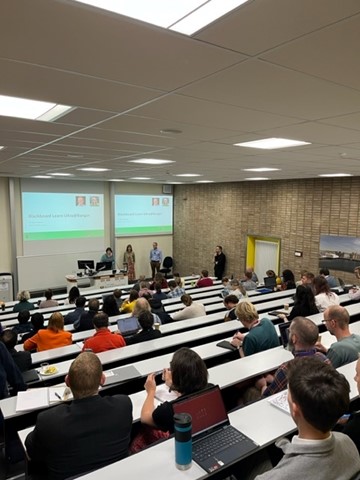
We’ve been using Vevox for over 3 years now and were pleased to see it being used in Welcome Talks offering students the opportunity to ask anonymous questions.
As leader of our PGCTHE programme, I keep an eye out for resources to help staff teach effectively. These include webinars, podcasts, online toolkits, publications and more. Topics include active learning, online/blended teaching, accessibility/inclusion, and effective learning design based on cognitive science. Below I’ve listed items that came to my attention in the past week. In the interest of clarity, our policy is to show the titles and descriptions in the language of delivery.
14/10/2024 Compassionate Assessment Event 5 Martin Compton, “Dr Compton is the lead for AI and innovation and for assessment design at King’s College London”
21/11/2024Compassionate Assessment Event 6 Dr. Juuso Henrik Nieminen, “Dr Nieminen has particularly focused on understanding the social effects of assessment on students’ inclusion, belonging and identities.”
Monthly series European Network for Academic Integrity, ENAI monthly webinarsfree open webinars on various topics related to academic integrity.
Subscribe to SEDA’s mailing list for email discussions about educational development and emerging teaching practices. This is one of the sources I use when identifying useful material for the Roundup.
Join the #LTHEchat on Twitter Wednesday nights for one hour of lively discussion about learning and teaching in HE. I often find out about good resources for the Roundup from the chat.
Please see the Staff Training booking page for training offered by the LTEU and other Aberystwyth University staff. I hope you find this weekly resource roundup useful. If you have questions or suggestions, please contact our team at lteu@aber.ac.uk. You may also wish to follow my Twitter feed, Mary Jacob L&T.
As leader of our PGCTHE programme, I keep an eye out for resources to help staff teach effectively. These include webinars, podcasts, online toolkits, publications and more. Topics include active learning, online/blended teaching, accessibility/inclusion, and effective learning design based on cognitive science. Below I’ve listed items that came to my attention in the past week. In the interest of clarity, our policy is to show the titles and descriptions in the language of delivery.
12/9/2024 WonkHE, Last night a chatbot eased my strife, “Join Wonkhe and Salesforce as we explore how AI powered technology can be deployed in building student agency in wellbeing”
14/10/2024 Compassionate Assessment Event 5 Martin Compton, “Dr Compton is the lead for AI and innovation and for assessment design at King’s College London”
21/11/2024Compassionate Assessment Event 6 Dr. Juuso Henrik Nieminen, “Dr Nieminen has particularly focused on understanding the social effects of assessment on students’ inclusion, belonging and identities.”
Currant, N., Hill, V. & Bunting, L. (6/9/2024), Episode 47 Compassionate Assessment (30-minute audio recording), Talking HE Podcast series with Santanu Vasant
Monthly series European Network for Academic Integrity, ENAI monthly webinarsfree open webinars on various topics related to academic integrity.
Subscribe to SEDA’s mailing list for email discussions about educational development and emerging teaching practices. This is one of the sources I use when identifying useful material for the Roundup.
Join the #LTHEchat on Twitter Wednesday nights for one hour of lively discussion about learning and teaching in HE. I often find out about good resources for the Roundup from the chat.
Please see the Staff Training booking page for training offered by the LTEU and other Aberystwyth University staff. I hope you find this weekly resource roundup useful. If you have questions or suggestions, please contact our team at lteu@aber.ac.uk. You may also wish to follow my Twitter feed, Mary Jacob L&T.
A big thank you to all the staff who have signed up to the Blackboard Assignment with SafeAssign pilot. There’s still time to volunteer if you are interested (email elearning@aber.ac.uk).
Since the last blog post, we have made SafeAssign available for use in Blackboard Assignments. We have also held the first two training sessions. More training sessions will be organised for semester one – visit the Events and Training page to book a place.
We’ve been exploring some of the options for marking in Blackboard Assignment that staff might find useful:
Delegated marking allows staff to mark essays by group. If you divide up marking in your modules between several members of staff, then delegated marking will help you.
Parallel marking allows two staff to mark a piece of work independently without seeing each other’s comments or marks.
Anonymous comments. By default, marking comments in Blackboard Assignment contain the name of the staff member marking. If this is not appropriate for your marking, you can make them anonymous (see below).
Please note that deleted Blackboard assignments can be recovered for up to 30 days after deletion. If you need deleted assignments restored, please contact elearning@aber.ac.uk as soon as possible, providing details of module and the assignment name.
Anonymous Comments
When you create a comment, click on the anonymous marking icon
You can edit existing comments to make them anonymous by clicking on the comment. Click on the three dots in the top right-hand corner of the comment and then click on Anonymous.
To help your students use Blackboard Assignment to submit their work and find their feedback, we strongly recommend that you include the following FAQs in Assessment and Feedback Learning Module in your Blackboard course:
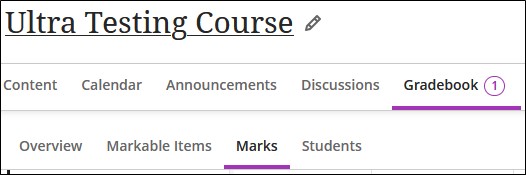
The September Blackboard update includes enhancements to the Course Content Page, introduces Knowledge Checks in Documents, changes to assessments, feedback & grades hidden using Release Conditions, and an Overview tab in the Grade book to aid grading.
Course Content Page enhancements
The September update to Blackboard sees enhancements to the course content page.
The enhancements include:
Greater visual depth
Changed Content Page layout
Differentiation among course elements
Greater visual depth
The new design incorporates:
Subtle gradients and softer edges
A more cohesive colour palette with inviting, warmer tones
More intuitive navigation, which reduces cognitive load and increases focus on the content
We’re the Learning and Teaching Enhancement Unit. Based in Information Services, we work with staff across the university to support and develop learning and teaching. We run a wide range of activities to do this.
Each module has its own dedicated course in Blackboard. These courses contain online content, such as reading lists, and teaching staff details. This is the main point of information for your students for any given module, including access to lecture recordings and assignment submission. The University has a Blackboard Required Minimum Presence policy for all modules. Please see our staff guide for further information.
Lecture Capture: Panopto
When teaching in person, be aware that all lectures (that is, teaching where the focus is on information being transmitted from staff to students) should be recorded using Panopto, our Lecture Capture software. See details of our Lecture Capture Policy.
E-submission: Turnitin and Blackboard Assignment
At Aberystwyth University, students must submit all text-based and word-processed work electronically as outlined in the University’s E-submission policy. For this, we use our e-submission tools: Turnitin andBlackboard Assignment. Turnitin provides an automatic text matching functionality.
Polling tool: Vevox
Vevox is Aberystwyth University’s polling tool. Polling can be used in learning and teaching activities as well as meetings to make the session interactive and collaborative with many different possibilities for use.
Resources and further help
We have a number of Guides and FAQs to help you use our software.
Training Provision
To support all staff with their teaching, the Learning and Teaching Enhancement Unit runs a series of training sessions. These include:
practical sessions to familiarise staff with the different elements of the VLE,
the Active Learning agenda,
assessment and feedback,
accessibility,
presentation skills, and more.
artificial intelligence
We also offer a range of events and training programmes. You can find details of our annual CPD programme and book your place to attend via our Book a Course page. We deliver some sessions ourselves, while others are delivered by university staff whose teaching features good practice in those areas. Look for (L&T) in the session title.
Events
The Learning and Teaching Enhancement Unit runs a range of events, including the Annual Learning and Teaching Conference, Mini-Conferences, Mini-Fests, and Academy Forums. All of these are great opportunities to meet people from across the university and discuss Learning and Teaching issues and developments.
As leader of our PGCTHE programme, I keep an eye out for resources to help staff teach effectively. These include webinars, podcasts, online toolkits, publications and more. Topics include active learning, online/blended teaching, accessibility/inclusion, and effective learning design based on cognitive science. Below I’ve listed items that came to my attention in the past week. In the interest of clarity, our policy is to show the titles and descriptions in the language of delivery.
12/9/2024 WonkHE, Last night a chatbot eased my strife, “Join Wonkhe and Salesforce as we explore how AI powered technology can be deployed in building student agency in wellbeing”
Educause (19/8/2024), AI…Friend or Foe?, Educause Showcase series (online toolkit), “Effectively navigating the promises and perils of AI requires a careful evaluation of institutional preparedness, a clear set of objectives, and a policy framework to facilitate progress.”
CAST (3/7/2024), EPISODE 21: Lindsay E. Jones, CAST, “CAST’s Lindsay E. Jones shares how the Universal Design for Learning is helping educators personalize rigorous instruction for an ever more diverse population of students” (20-minute audio recording)
Monthly series European Network for Academic Integrity, ENAI monthly webinarsfree open webinars on various topics related to academic integrity.
Subscribe to SEDA’s mailing list for email discussions about educational development and emerging teaching practices. This is one of the sources I use when identifying useful material for the Roundup.
Join the #LTHEchat on Twitter Wednesday nights for one hour of lively discussion about learning and teaching in HE. I often find out about good resources for the Roundup from the chat.
Please see the Staff Training booking page for training offered by the LTEU and other Aberystwyth University staff. I hope you find this weekly resource roundup useful. If you have questions or suggestions, please contact our team at lteu@aber.ac.uk. You may also wish to follow my Twitter feed, Mary Jacob L&T.
A warm welcome to new students joining us and those who are returning to study at Aberystwyth University.
In this blogpost, we will outline the changes that have been made to your digital learning environment, Blackboard, ready for the start of the academic year 2024-25.
If you need help using Blackboard, see our Student Guide which contains all kinds of useful information.
We’ve also got FAQs available for the other tools that we support, including Turnitin for e-submission and Panoptofor lecture capture.
Updated Template
All courses have been created this year using a slightly different template.
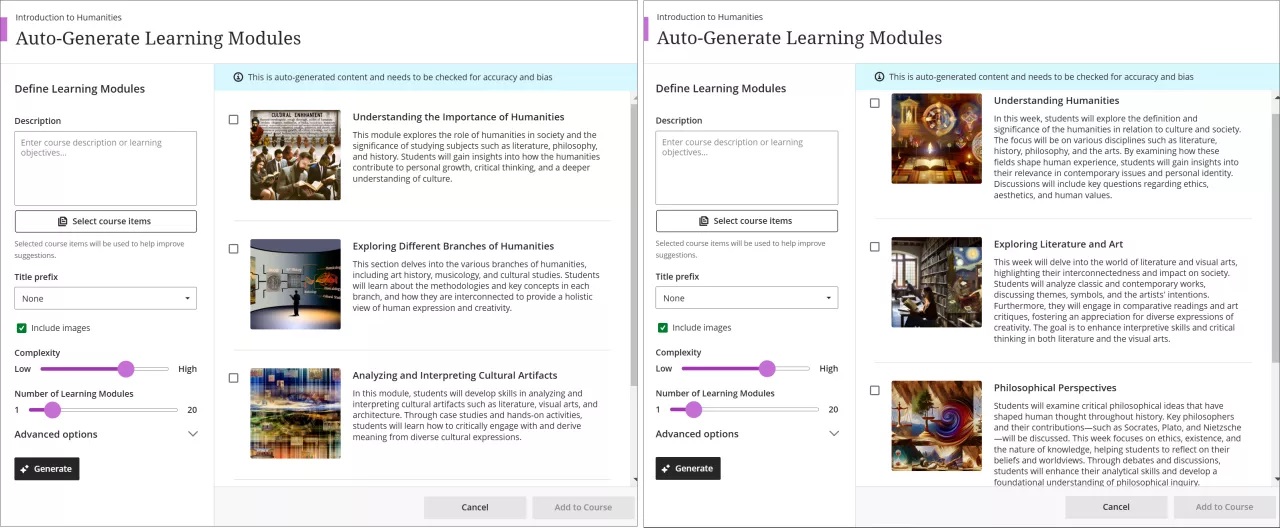
Module Information and Assessment and Feedback have been replaced with Learning Modules. Learning Modules are a more visual way to organise and arrange content.
In Module Information you can expect to find items relating to the administration of the course.
In Assessment and Feedback you can expect to find your submission points, assignment briefs, and marking criteria.
You might find that your lecturers have also used Learning Modules for your Learning Materials.
Progress Tracker
Another change is that Progress Tracker has been turned on by default on all content on your course. This allows you to track your progress through the course by marking tasks as complete. Blackboard’s guidance provides further information.
Blackboard Ally
A reminder that we have Blackboard Ally enabled on all your courses. Blackboard Ally allows you to download content into different formats. This includes .mp3 files, immersive readers, and electronic Braille. For help, look at Ally guidance.
Blackboard Assignment
We will be running a series of pilots with some courses across the University using Blackboard Assignment. For those of you used to submitting via Turnitin, Blackboard Assignment offers similar functionality. We have a dedicated student FAQ on how to submit using Blackboard Assignment.If you have any difficulties submitting please contact Information Services (is@aber.ac.uk) and your academic department.
Departmental Organisation
Lastly, the final stage of our Ultra project was to move Departmental Organisations onto Ultra. Organisations are similar to Courses but they are not modules that you can take. Organisations are used to provide you with useful information about your Department. They are also used for training and test purposes, such as the Referencing and Plagiarism quiz. You can access your Organisations from the left-hand menu in Blackboard.
If you have any questions about using Blackboard, please contact Information Services (is@aber.ac.uk).
As leader of our PGCTHE programme, I keep an eye out for resources to help staff teach effectively. These include webinars, podcasts, online toolkits, publications and more. Topics include active learning, online/blended teaching, accessibility/inclusion, and effective learning design based on cognitive science. Below I’ve listed items that came to my attention in the past week. In the interest of clarity, our policy is to show the titles and descriptions in the language of delivery.
Online events and webinars
August
August Equity Unbound, MyFest exploring “open educational practices, Artificial Intelligence and digital literacies, critical pedagogy and socially just education, wellbeing and joy, community building and community reflection”
Alang, N. (8/8/2024), No god in the machine: the pitfalls of AI worship: The rise of artificial intelligence has sparked a panic about computers gaining power over humankind. But the real threat comes from falling for the hype, The Guardian
Kukulska-Hulme, A., Wise, A.F., Coughlan, T., Biswas, G., Bossu, C., Burriss, S.K., Charitonos, K., Crossley, S.A., Enyedy, N., Ferguson, R., FitzGerald, E., Gaved, M., Herodotou, C., Hundley, M., McTamaney, C., Molvig, O., Pendergrass, E., Ramey, L., Sargent, J., Scanlon, E., Smith, B.E., & Whitelock, D. (2024),Innovating Pedagogy 2024: Open University Innovation Report 12 (Milton Keynes: The Open University)
Monthly series European Network for Academic Integrity, ENAI monthly webinarsfree open webinars on various topics related to academic integrity.
Subscribe to SEDA’s mailing list for email discussions about educational development and emerging teaching practices. This is one of the sources I use when identifying useful material for the Roundup.
Join the #LTHEchat on Twitter Wednesday nights for one hour of lively discussion about learning and teaching in HE. I often find out about good resources for the Roundup from the chat.
Please see the Staff Training booking page for training offered by the LTEU and other Aberystwyth University staff. I hope you find this weekly resource roundup useful. If you have questions or suggestions, please contact our team at lteu@aber.ac.uk. You may also wish to follow my Twitter feed, Mary Jacob L&T.