What’s new in Blackboard April 2026

In the April update, we want to draw your attention to the following Blackboard enhancements:

  • Assignments
    • Assignment submission type
    • SafeAssign file size
    • Adjusting individual grades in group submissions
  • Tests
  • AI Conversations
  • Discussions
  • Announcements

Blackboard Assignment

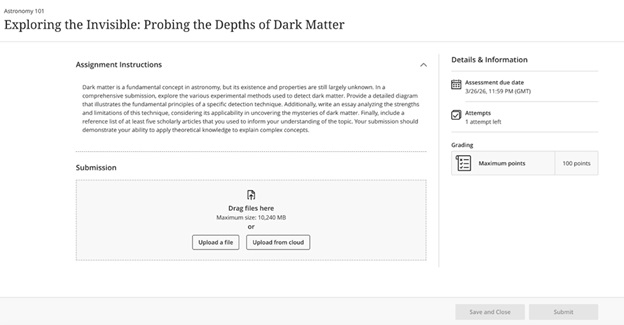
Specify assignment submission type

Instructors

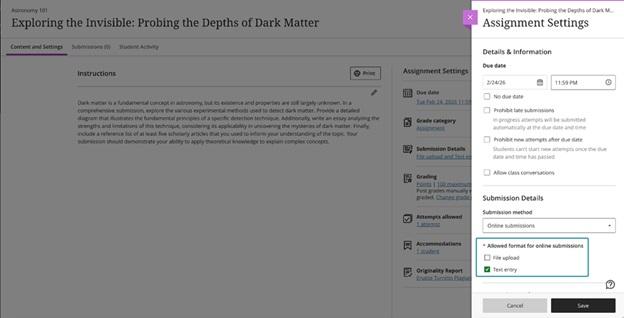
When creating or editing an assignment, instructors can define the expected submission type to guide how students submit their work. Selecting a specific submission type streamlines the student experience and reduces ambiguity about what is required.

Instructors can select one or more expected submission types when configuring an assignment:

  • File upload
  • Text entry

By default, File upload and Text entry are both selected.

The selected submission type is visible in assignment settings and student‑facing details. Instructors can change the selected submission type until students have started submitting attempts.

Image 1: Instructors can choose one or more submission types when configuring an assignment.

Students

Students are informed of the expected submission type and see a submission workflow optimized for that format.

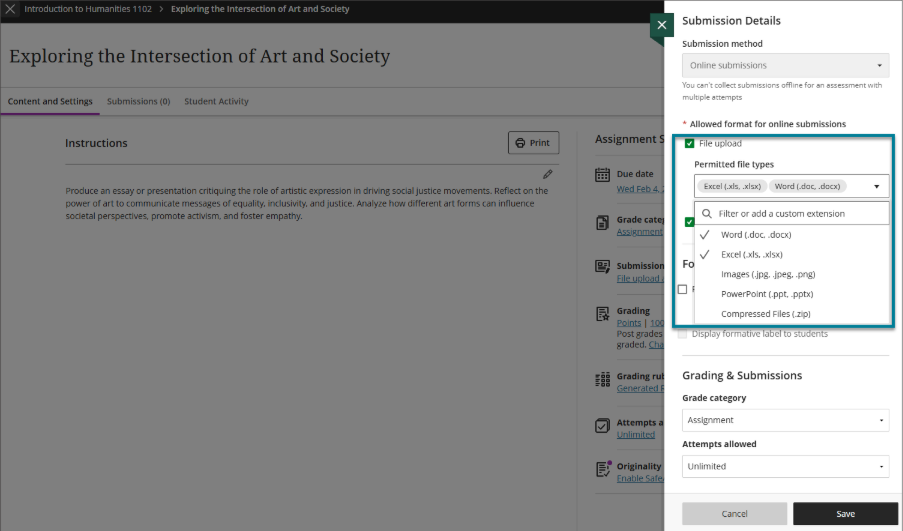
  • File submissions display a dedicated file drop zone where students can upload, preview (when supported), and remove files.
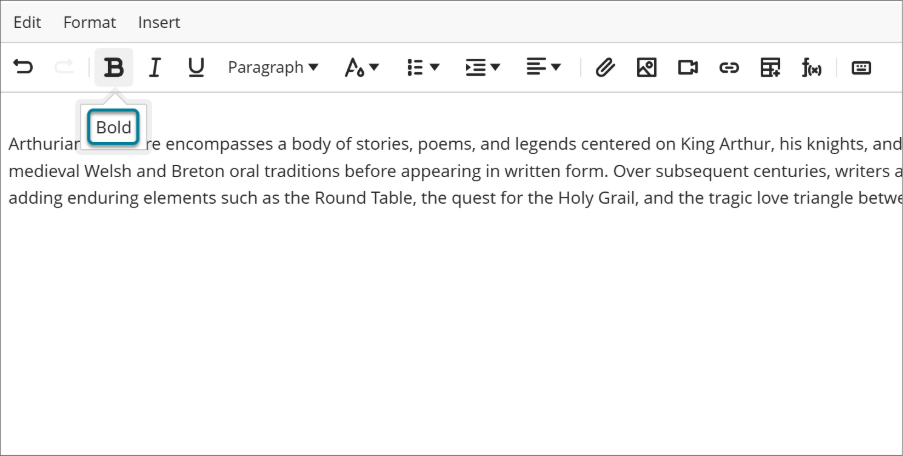
  • Text submissions provide a streamlined rich text editor experience without a general file attachment option and include access to the Content Market for supported tools.

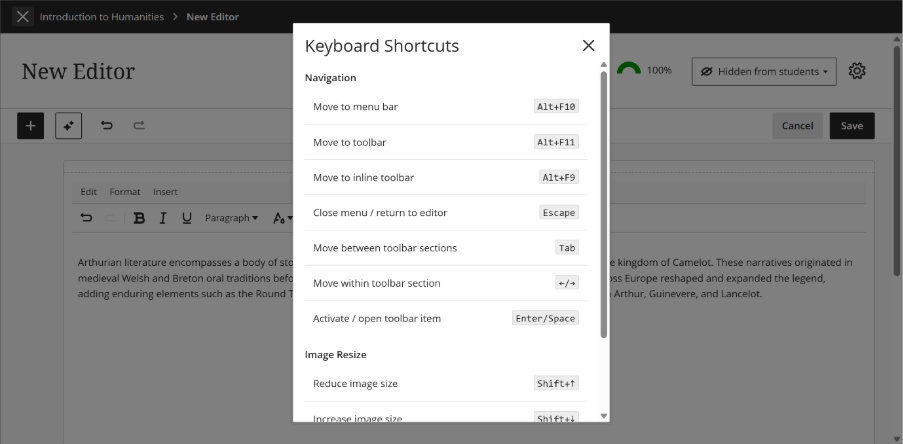
Image 2: Students have a submission workflow optimized for the selected submission type.

Note that if you are using Blackboard for Panopto assignments, you need to have Text entry enabled.

Increased SafeAssign file size limit to 25 MB for Direct Submit

The SafeAssign file size limit for DirectSubmit submissions increased to 25MB. This change supports larger documents that include images, tables, and complex formatting, reducing submission issues for students.

Existing submissions and SafeAssign reports remain fully compatible, and related system limits were reviewed to ensure continued stability.

Adjust grades for individual student attempts in group submissions

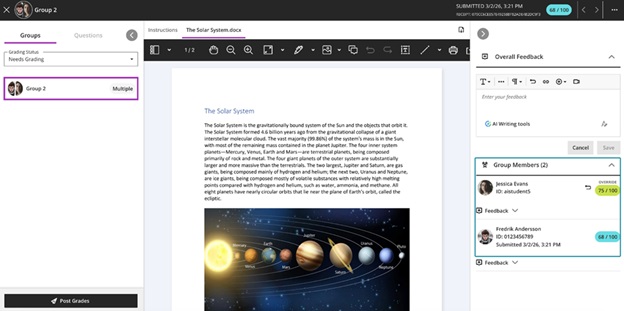
Flexible Grading has been extended to allow instructors to adjust attempt grades for individual students within a group submission. This update ensures that grades for group submissions can accurately reflect each student’s individual contribution, even when work is submitted as a single group attempt.

Instructors can override a group attempt score for individual group members directly from the grading interface. The interface clearly indicates when grades differ across group members, and adjustments can be removed by restoring a student’s grade to match the group attempt score.

Image 1: Instructors can adjust grades for individual students within a group submission.

Tests

Improvements to multiple choice and multiple answer questions

See below for changes to multiple choice and multiple answer questions:

  • For the multiple choice question, the default number of answer options a student can select from 4 to 1 has been modified.
  • When creating or editing a multiple choice or multiple answer question, instructors can change the number of answer options that a student can select.
  • Multiple choice answer options alphabetical labels (A, B, C, D) have also been restored.

AI Conversations

Use Message Limits

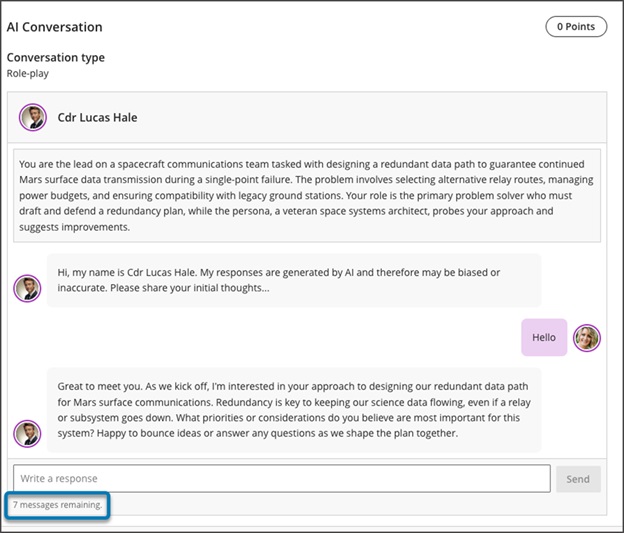
Instructors can now guide the length of AI‑supported conversations, including Socratic Questioning, by setting message limits. These controls help students understand when to complete an interaction and keep conversations focused on the intended learning activity.

Instructors

When instructors configure an AI conversation, they can set a maximum message cap to shape the conversation duration.

Image 1: Message limit settings for an AI conversation

Students

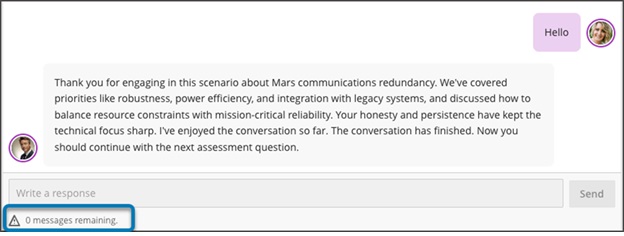
Students track their remaining responses during a conversation through a dynamic label. The label shows a caution icon when two responses remain. After the conversation reaches the message cap, students cannot add more responses. The message limit sets clear expectations for participation and completion.

Image 2: Student messaging guidance during an active interaction.

Discussions

Review both sets of Discussion due dates across multiple views in Blackboard

Blackboard now surfaces both sets of due dates and participation requirements for Discussions across key areas of the application. This improvement builds on the recent addition of a second due date and participation requirement. Instructors and students get clearer expectations wherever they access Discussion details.

Instructors and Students

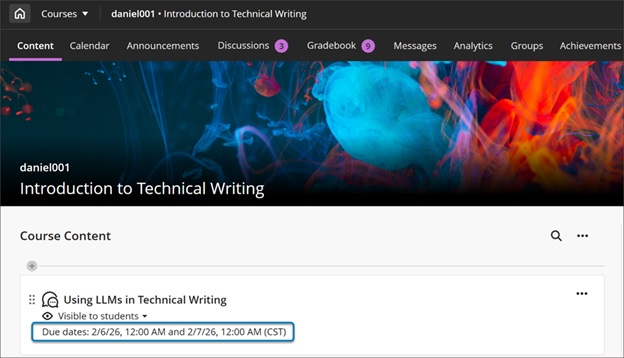
When instructors create a discussion with two due dates and participation requirements, both sets of requirements appear on the Course Content page, Discussion pages, the Gradebook student and instructor views, and the instructor’s Discussion analysis panel. Students can track expectations throughout the workflow without navigating back to the discussion itself.

Image 1: On the Course Content page, both due dates and participation requirements are displayed. For all entry points for Discussions, both dates and requirements are displayed.

  • On the Course Content and Discussion pages, both due dates and their requirements appear together for quick reference.
  • In the Gradebook student view, both dates appear.
  • Instructors also get a new Due Dates and Requirements section in the grading view for an individual student. This section shows both due dates and the student’s progress toward each requirement.

Announcements 

Handle images as thumbnail links in Announcement emails

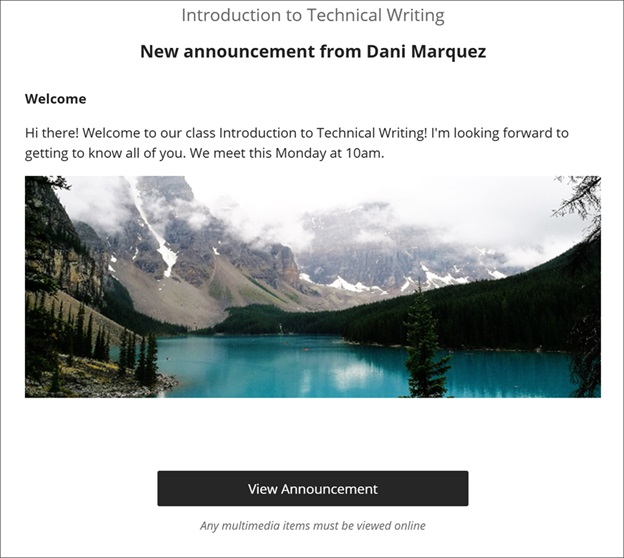
Announcement emails now show images as thumbnail links instead of long URLs. This update gives users a clearer preview of announcement content and provides a direct path back to the full announcement in Blackboard. When users select a thumbnail, the system opens the original announcement so they can read it with full context.

Instructors and students

Announcement emails display a small thumbnail for each image instructors include in an announcement. Each thumbnail links to the announcement in Blackboard, so users return to the complete content instead of opening the image file by itself. Instructors continue to create announcements the same way they have before.

Image 1: Announcement email showing images as thumbnail links that open the announcement in Blackboard.

If you have any enhancements to request from Blackboard, please get in touch with us via elearning@aber.ac.uk.

What’s new in Blackboard – February 2025

In the February update, Blackboard has improved the workflows for Assignments and Tests and further enhanced the AI Design Assistant. Additionally, there are new options for managing and creating content and some improved accuracy when uploading grades and feedback.

Assignments, Tests, Marking and Grades

Conversion of existing assignments to new assignment workflow

The Create Test and Create Assignment workflows used to share the same content settings, but the workflows have been separated since last August. This month’s update will run an automatic bulk conversion of any assignments created before August 2024 to ensure that all assignments past and present will benefit from this new workflow. See the August 2024 Blog for details on the workflow differences.

Assignments following the conversion: There will be no option to add questions to assignments and attempts will only be created with students interact with the assignment, such as submitting a file or adding content. Clicking on the assignment will not create an attempt.

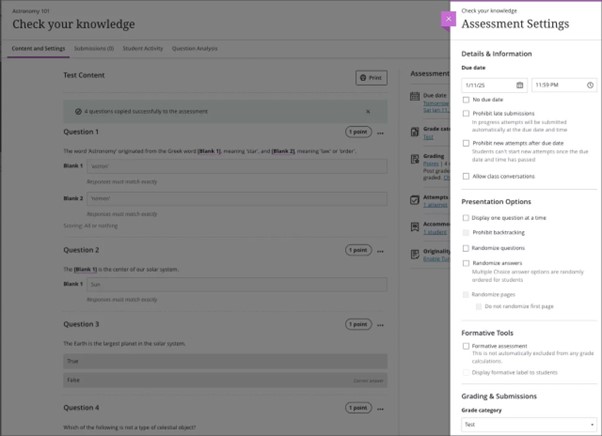
Tests following the conversion: Tests with questions will remain the same. Any tests without questions will be set to Hidden from students. When you copy tests over from previous modules, they will also be set to Hidden from students. Some assignment-specific options have been removed from the test settings menu:

  • Collect submissions offline
  • Use grading rubric
  • Maximum points
  • 2 grades per student
  • Peer review

Additionally, the functionality for student visibility options and release conditions for tests have been updated. Now, instructors must add one or more questions to their test to make it visible to students or to add release conditions. This ensures that students only see assessments that they can actively engage with.

Image 1: Settings panel with assignment-specific options removed.

Settings panel with assignment-specific options removed

Masking access codes for Tests

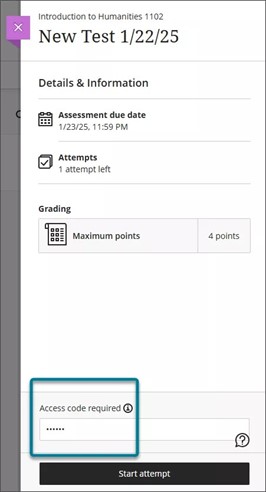
In the past, when an exam invigilator entered an access code for an online exam using Blackboard Tests, the code was visible on the screen when entered. This compromised the security of the testing environment. Now, the code is masked (******) to ensure enhanced security. An option to view the code is available but the default state keeps it hidden which provides better privacy and protection during exams.
Image 2: Masked Access Code.

Screenshot of Masked Access Code

Improved accuracy when uploading grades and feedback

Instructors can now upload grades and feedback for assignments, journals, and discussions with improved accuracy. Previously, uploaded grades were always stored at the override level, which left any underlying attempts or submissions ungraded. This caused the Needs Grading and New Submission flags to remain visible, even when grading had been completed offline. Uploaded grades and feedback are now correctly mapped to the corresponding attempt or submission which reduces confusion and provides better clarity for instructors. See guidance on Working Offline with Grade Data for further information.

AI Design Assistant

More generated questions and Learning Modules

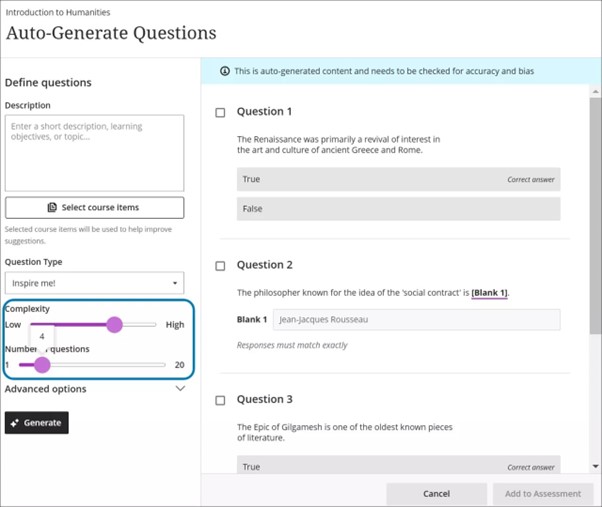
When using the AI Design Assistant, instructors can now set the number of questions generated for tests and question banks to a maximum of 20. The maximum number of learning modules that the AI Design Assistant generates also increased to 20. There is also an added option to exclude descriptions from learning modules generated by the AI Design Assistant. Instructors now have the option to write their own descriptions.

Image 3: The Auto-Generate Questions page displays a new maximum number of questions of 20.

Screenshot of the  Auto-Generate Questions page displays a new maximum number of questions of 20.

For more information on the tools available with the AI Design Assistant see Blackboard AI Design Assistant Tools.

Managing and Creating Content

New image block on Document creator

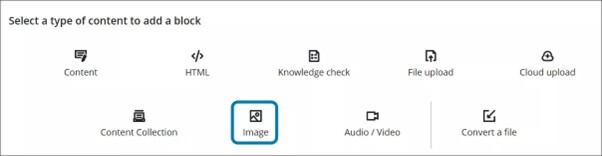
Blackboard have added a new image block to Documents. Image blocks are used to upload your own images, use the AI Design Assistant to generate images, or select images from Unsplash. Image blocks can be moved throughout a Document, just like other block types. You have the option to resize images, set height, and maintain aspect ratios in image blocks.

Image 4: The new image block option in Documents.

A screenshot of the new image block option in Documents.

A dedicated image block makes adding images more apparent. Adding images via the image block also reduces white space around images and provides greater control over content design. For more information on using Documents in Blackboard see Enhancements to Documents.

Changing Folders to Learning Modules

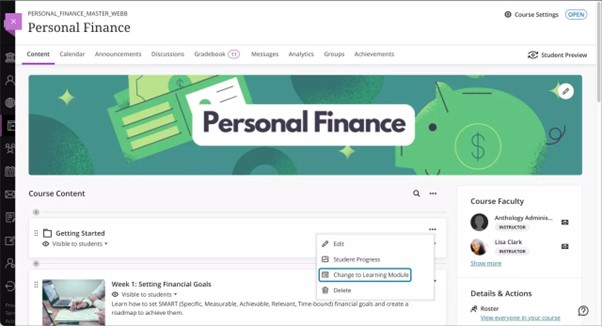
Instructors can now change a folder to a learning module or a learning module to a folder. Benefits of changing a folder to a learning module include:

  • Thumbnail images: Learning modules come with thumbnail images, which provide a visually appealing course experience.
  • Forced sequencing: Instructors can force students to navigate learning modules in linear paths.
  • Progress bar: Learning modules have a progress bar for students that highlights the number of items that they need to complete and their progression on those items.
  • Previous and next navigation: Students can quickly navigate to the next or previous item in a learning module.

It is also possible to convert a learning module to a folder, though we would not recommend this, as it will remove the added benefits of using learning modules as listed above.

Image 5: The new option to change a folder to a learning module in the dropdown menu.

Screenshot of the new option to change a folder to a learning module in the dropdown menu.

Idea Exchange

This section aims to keep you updated on progress of enhancements requested on the Blackboard Anthology Idea Exchange. The following three items have changed their status to ‘Planning to implement’:

  • Support for a Dark Mode in Ultra Courses
  • Ability to add metadata to questions in tests and banks
  • Organising Pools

If you have any enhancements to request from Blackboard, please get in touch with the Digital Education Group.