Further to our previous blogpost, Turnitin has now released a statement to address the concerns that staff and students have over the proposed user license agreement changes:
In response to concerns raised by UK universities and colleges, which have been channelled through UCISA, Turnitin postponed the issue of a new End-User Licence Agreement (EULA) until September 2027.
Turnitin have also committed to redrafting the EULA and will work in partnership with UCISA who represent educational institutions across the UK to address any concerns and clarify key questions.
Turnitin has confirmed that no student or staff data has been used to develop any generative artificial intelligence (AI) models or large language models (LLM), and that they have no plans to use student essays in this way.
Turnitin recognise the growing concerns around data privacy and AI. They are therefore fully committed to the collective work that they are engaged with through the UCISA representation group and their institutional members.
This working partnership demonstrates Turnitin’s commitment to protecting student and staff data.
If you have any questions or concerns about this, you are welcome to contact the Digital Education Team on elearning@aber.ac.uk.
In just over a week’s time, the August Blackboard update will be released. This includes an overhaul of the Gradebook. Please see below for further information.
The monthly August Blackboard release has a new user interface for the Gradebook.
Given the nature of this update, we have a separate blogpost dedicated to it.
If you have any questions about the updated Gradebook or grading, please contact the Digital Education Team (elearning@aber.ac.uk).
Every course has the Gradebook, which is used to manage all aspects of the administration of marks. It can be accessed via the top menu of Blackboard courses.
As part of this update, the following processes are not changing:
Grades, calculations, and overall grade configuration
Grade schemas and grading settings
Course-level accommodations
The List View
All existing grades and submission history
The component marks transfer process also remains unchanged.
Change 1: Default view
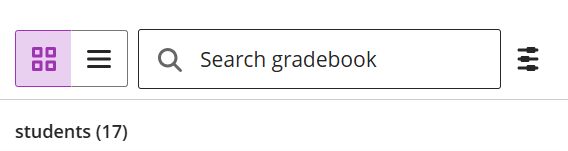
The default view of the Gradebook is now the grid view
You can swap between the grid view and the list view by clicking between the views:
Change 2: To do list
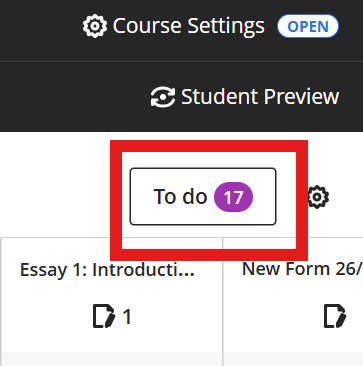
The Gradebook Overview is now called the To Do List which is available in grid and list views:
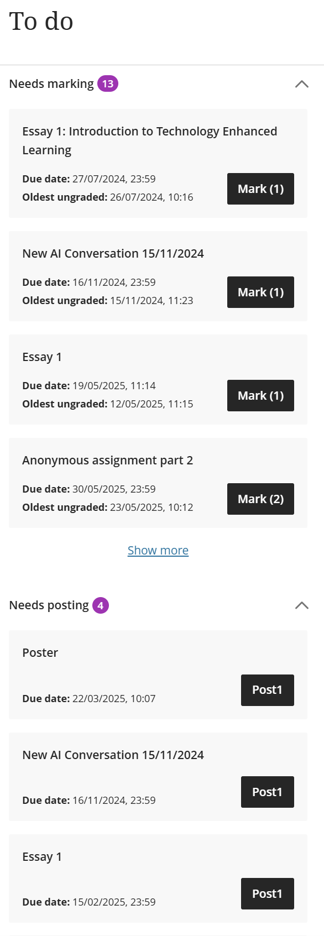
From here, you can see what work there is to mark and post:
A reminder that marks need to be posted in order to be included in the marks transfer.
Change 3: Entering Grades
The ways to enter grades into columns has changed.
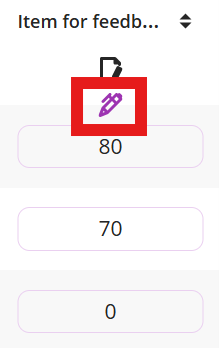
Click on the pencil icon to change and enter the grade:
You can then post the marks from this screen by clicking on the post icon:
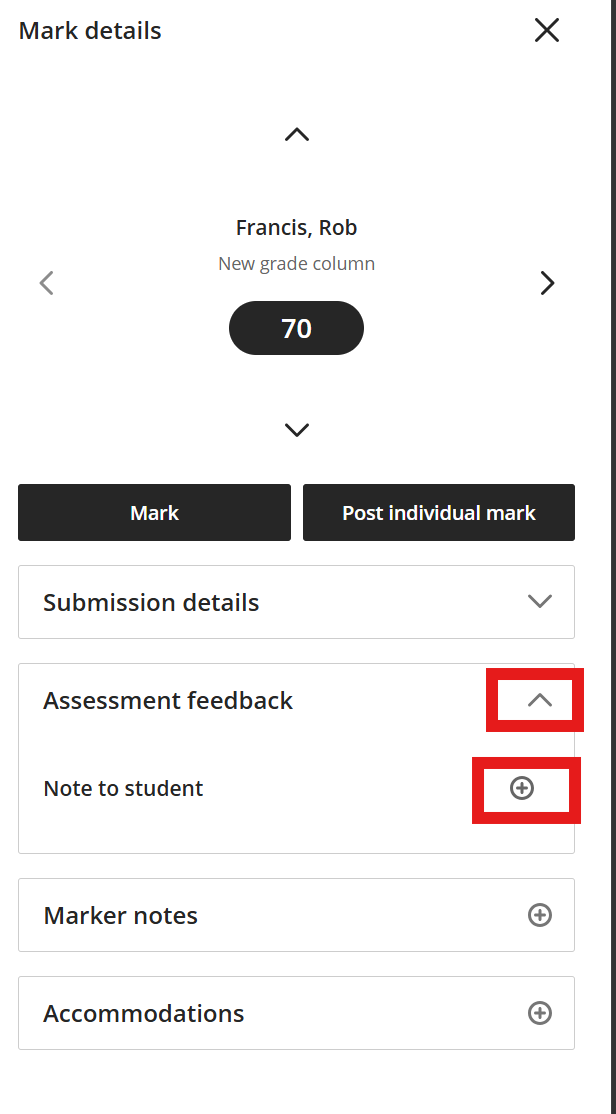
You can also leave feedback from this view by clicking on the mark
If you want to mark and leave feedback on all Blackboard marked items, click on this icon:
This will then open the assignment mark screen.
Change 4: Updating and editing columns
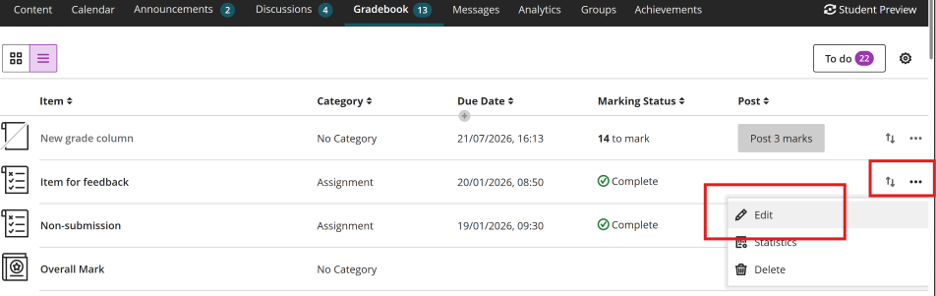
Editing columns now take place via the list view.
Change 5: Filtering by merged module
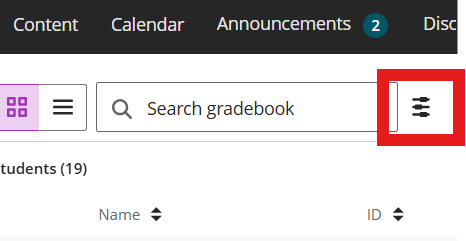
It is possible to filter the gradebook using Merged Modules so that you only see the information for students on the relevant modules.
Click the filter button highlighted below and choose from the dropdown for merged courses:
Change 6: File upload and download gradebook
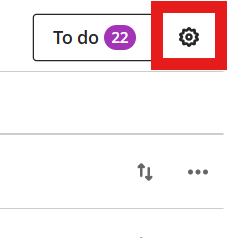
The functionality for downloading and uploading to the gradebook has moved.
Click on the settings cog:
Choose Download marks or Upload marks depending on what you want to do.
Change 7: Checking the visibility of a column
The visibility status of columns can no longer be seen in the grid view.
To check the visibility of the column, navigate to the list view:
You can amend the visibility of the column by clicking on the ….
We are now working to update our guidance to reflect the changes in the Gradebook.
If you need any further information or have any questions, please contact us on elearning@aber.ac.uk.
All courses for 2026-27 have been created and are available to staff in Blackboard.
All AU Blackboard course sites use an agreed template with areas for core information along with agreed content for university-level policies.
The course template is agreed by the Quality and Standards Committee annually. Module Coordinators have responsibility for the organisation of materials in their courses. Staff should not delete template content.
As we start to move to the assignment period for semester 2, we start to look at creating courses ready for 2026-27.
We will create courses for 2026-27 on Monday 3 June 2026.
The courses will be available to staff as soon as we create them.
Students will not be enrolled on the courses until they complete registration in September.
As with previous years, there will be one standard template for all courses at Aberystwyth. The language of the template depends on the language of delivery in AStRA. If the course is delivered 100% through the medium of Welsh, then a Welsh template will be used. For 1-99% through the medium of Welsh, a bilingual template will be used. If the course is registered to be delivered 0% through the medium of Welsh, then an English template is used.
Our Blackboard Required Minimum Presence, E-submission, and Lecture Capture policies are in the stages of being finalised.
We will communicate these in due course.
If you have any questions about course creation, please don’t hesitate to contact us on elearning@aber.ac.uk.
In November, we took part in Blackboard Ally Fix your Content Day, making the content of our Virtual Learning Environment even more accessible. We placed 3rd in the UK and 60th on the international leaderboard.
We’re planning our next Mini Conference in collaboration with colleagues in Student Journey for April 2026. Further information will be made available soon.
And our 14th Education and Student Experience Conference will take place between 8-10 September 2026. Keep an eye out for updates, call for proposals, and external speaker announcements.
Turnitin has announced the retirement of their Turnitin app at the end of the year, December 2025.
The Feedback Studio iPad app will be retired and no longer available. Instructors can continue to access Feedback Studio as usual through Blackboard. This includes mobile devices and tablets.
Turnitin are working on developing a New Standard Assignment, so instructors can review and provide feedback on student work from tablets without needing a separate app. We will release comms regarding this new service in due course.
If you have any questions or concerns about this, please don’t hesitate to contact us (elearning@aber.ac.uk).
Over the summer there have been some updates to Blackboard Ally which colleagues will find help them to fix issues with images and PDFs in Blackboard.
AI Auto-generate description
The AI auto-generate description tool has been improved to write better alternative text for charts, text in images, STEM content, and handwriting in images. Like all the AI tools in Blackboard staff can edit any aspect of the AI output and adapt it if needed. The AI tool also provides a good starting point for learning more about writing alternative text. And if you use Blackboard in Welsh, the AI tool will create Welsh alternative text.
To use the AI tool:
Click on the Ally indicator for your image (or access it via Books and Tools > Ally Adroddiad Hygyrchedd / Accessibility Report > Content)
Under Edit image description, click Auto-generate description
You can then click Save to use the description or edit the description before clicking Save.
If you don’t want to use the description, click Remove from image, and type your own description.
OCR layer on scanned documents
Around 15% of PDFs in 2024-25 courses were non-OCR documents. This causes a problem for anyone who needs to change the size of the text or use a screen reader because the text appears as an image rather than readable text. Ally now provides tools to add a readable OCR layer on top of a non-OCR document. The quality of this layer will depend on the nature of the content (typewritten documents work better than images or handwriting) as well as the quality of the scan.
We suggest that you try the OCR layer tool and see whether it may help you to provide more accessible PDFs. Remember that you can also use the Library Digitisation service which provides OCR readable scans of journal articles and book chapters.
To use the OCR layer:
Click on the Ally indicator for your image (or access it via Books and Tools [Llyfrau ac Offer] > Ally Adroddiad Hygyrchedd / Accessibility Report > Content)
Click on the Preview and Apply button to add the layer
A preview will appear – use your mouse to highlight the text on the preview. This will show you what text will be add to the file.
If you are happy to use it, click Apply. If not, choose Cancel
If you don’t use the OCR layer, the Learn how to fix PDFs button will give you options for adding a library reference.
PDF Language and Title
PDFs without language or title set can now be fixed directly in Ally:
Click on the Ally indicator for your PDF (or access it via Books and Tools > Ally Adroddiad Hygyrchedd / Accessibility Report > Content)
Under Add PDF Language, select the language of the document and click Apply fix
Type the title of your document in the Set PDF Title box and then click Apply fix.
Guidance for students
To help you encourage your students to use the Ally Alternative Formats, we have a Learning Object Repository (LOR) item on Ally that you can use in your course. See our FAQ on adding an item from the LOR to your course.
More changes are planned for Ally over the next three months, and we’ll keep colleagues updated via the blog. For more information on Ally, have a look at the Ally help pages
We’re pleased to announce that Generative AI Assessment Statements are now available in the Blackboard Learning Object Repository.
This is part of the work that Library and Learning Services are undertaking in collaboration with UndebAber and Academic Registry.
The aim of this work is to make it clear to students the expectations regarding their engagement and use of Generative AI in learning and teaching.
There are three statements available in the Learning Object Repository:
No Generative AI Tool use for this assessment
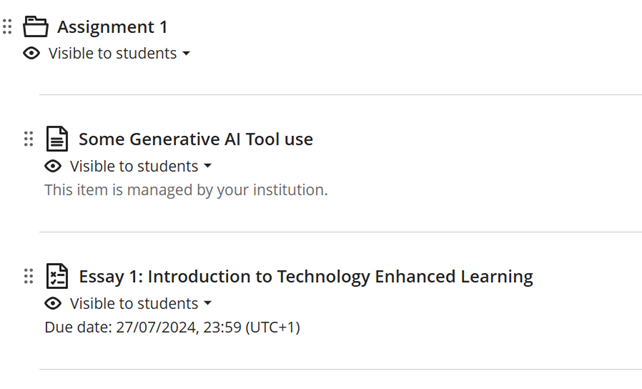
Some Generative AI Tool use for this assessment
Generative AI Tool use expected for this assessment
Each of the statements gives advice and signposts students to additional support.
Colleagues can copy these statements into the relevant area of the course. As acceptable levels of use of Generative AI vary between individual assessments, it’s recommended that the statements are copied into the relevant assessment folder.
In addition to the Generative AI Assessment Statements, a Generative AI Tool Use Statement is also available. This statement has been developed by colleagues in the Department of Law and Criminology and gives students the opportunity to outline how they have used Generative AI in their assignments.
If you have any questions about using the Learning Object Repository, please contact elearning@aber.ac.uk.