What’s new in Blackboard March 2026

In the March update, we want to draw your attention to the following Blackboard enhancements:

  • Updates to tests:
    • Anonymous grading by question
    • Question title field relocated
    • Partial credit Multiple Choice Questions and Multiple Answer
  • AI Design Assistant Content Editor
  • Graded Discussions
  • Blackboard Assignment file limits

Anonymous Grading by Question in Blackboard Tests

Instructors can now grade anonymous by question in addition to grading anonymously by student.

When grading anonymous test submissions in Question View, the interface replaces the student’s name, avatar, and ID with an anonymous identifier and a blank avatar. All functionality available when grading non‑anonymous submissions by question is also available when grading anonymously. When anonymous grading is enabled, related APIs no longer return identifying information. This applies to the Essay Question.

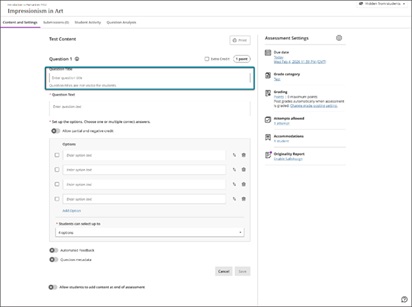
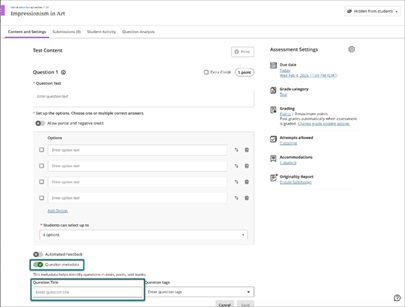
Question Title field relocated

We moved the Question Title field from the beginning of the question authoring workflow to the bottom, underneath the Question metadata field. Moving this field ensures that titles remain an optional metadata element and reduces cognitive load during question creation.

Image 1: Before this enhancement, the Question Title field was at the top of the question authoring workflow.

Image 2: Now, the Question Title field is at the bottom of the question authoring workflow, underneath the Question Metadata field.

Partial credit limits removed for Multiple Choice and Multiple Answer

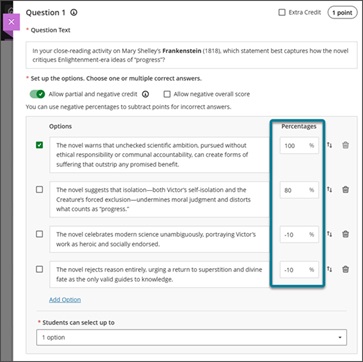
We updated the partial credit system for Multiple Choice and Multiple Answer questions to allow instructors to assign credit values without the requirement that all designated values sum to 100%. This change supports more flexible grading strategies and enables instructors to represent varying levels of conceptual understanding without adjusting values to meet a fixed total.

The system now allows instructors to enter any partial credit value for each option within a range of –100% to +100%. Validation continues to warn instructors if total values exceed 100%, but it no longer blocks question setup. Instructors may now also enter positive credit values for options that are not marked as the correct answer The total partial credit value for correct answers should be at least 100%, and it may exceed 100%. Negative marking continues to operate when enabled. Instructors can adjust credit values during regrading as well.

Image 1: Instructors can have answer options that do not sum to 100%.

Generate Knowledge Checks with AI

We expanded AI‑assisted authoring to support generating multiple choice Knowledge Checks within Documents. This enhancement allows instructors to create just‑in‑time formative assessments using AI‑generated questions based on the content of their Document and any selected course materials.

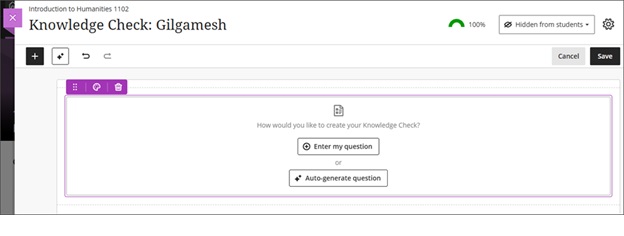
When inserting a Knowledge Check, instructors are now presented with two options: Enter my question or Auto generate question. Selecting Auto-generate question opens the Auto-Generate Question panel, which adapts the existing Question panel used in tests and question banks.

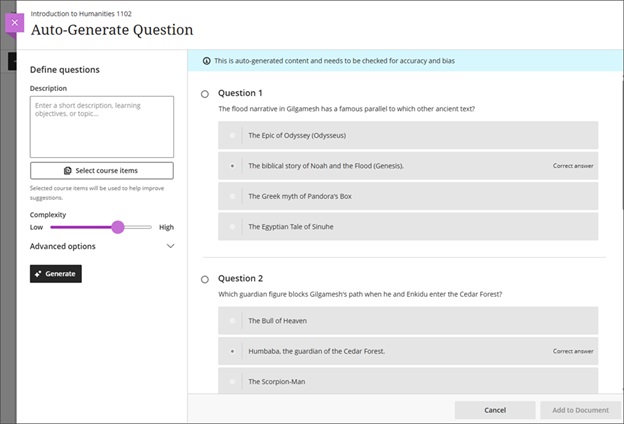
When using the Auto generate question option, instructors can define generation inputs with the following fields:

  • A description text field
  • A selector to choose course items to inform generation
  • A complexity level slider with a range from Low to High
  • Advanced options including an output language selector
  • An informational banner that states: “This is auto-generated content and needs to be checked for accuracy and bias.”

The system generates four multiple choice questions at a time. Each generated question displays with a radio button so that the instructor can select one question to add to the Document. The instructor can then modify the question, answer options, and feedback after insertion. If the instructor opens the Knowledge Check option but does not add a question, the placeholder block remains empty and behaves as other empty content blocks do.

All questions are generated using only text content from the Document. Consideration of additional media or files will be handled as part of a future release.

Image 1: Instructors can select Enter my question or Auto-generate question when creating a knowledge check.

Image 2: After the system generates questions, the instructor selects which question to add to the Document. After adding a question, instructors can edit the question, question options, and question settings.

Use the AI Design Assistant to suggest Document layouts

If you’re looking for ways in which you can make your Blackboard Documents more visually appealing, then use the AI Design Assistant to suggest Document layouts.

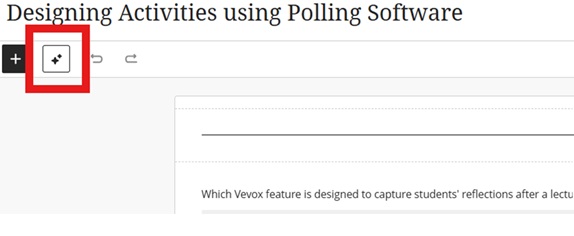
Go to your Document and click to edit the content. Then select the AI Design Assistant icon:

Image 1: AI Design Assistant icon highlighted.

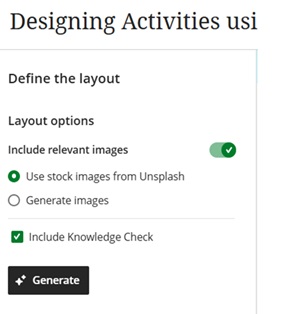
You can provide further information to define the layout:

Image 2: Options available in the layout.

Select Apply layout to save the suggested layout.

Add a second participation requirement and due date in Discussions

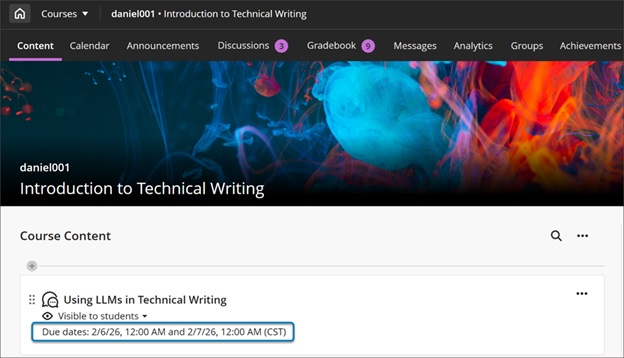
Instructors can now add a second due date with participation requirements for Discussions. This update builds on recent enhancements for discussion participation requirements and gives instructors clearer ways to set expectations for discussion activity. Students get transparent guidance for discussion expectations and progress indicators for their participation.

Instructors

Instructors can set how many posts and replies that students must complete across two due dates.

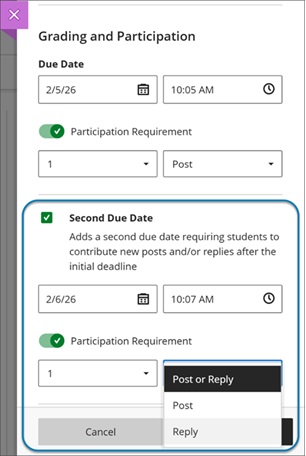
The option Grade discussion must be selected to add a due dates and participation requirements. Enter a time and date under Due Date and specify participation requirements. Selecting Second Due Date adds another due date with its own requirements.

Instructors can disallow student posts or replies after the final due date by selecting Stop discussion activity after last due date.

Image 1: Instructors can now add a second due date for Discussions. They can also specify the number and type of posts or replies that a student is required to make.

Students

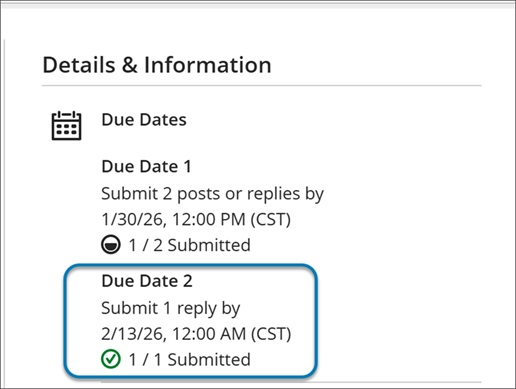
When students open a discussion, they find two clear participation requirements with separate due dates. As they post and reply, progress indicators update in real time.

Students can complete requirements in any order, but contributions after a due date won’t count toward that requirement. Once all requirements are met, the discussion is marked complete and Progress Tracking updates.

Image 2: In a Discussion, a student can find due dates in the Details & Information section in the discussion assignment.

Blackboard Assignment file limits

We increased the maximum supported SafeAssign file size from 10 MB to 25 MB. This enhancement supports modern academic workflows in which students frequently submit large documents. The increased file size applies to assignments and tests. Direct Submit will be included in a later release.

If you have any enhancements to request from Blackboard, please get in touch with us via bbbstaff@aber.ac.uk.

What’s new in Blackboard December 2025

In the December update, we want to draw your attention to the following Blackboard enhancements:

  • Specify participation requirements for Discussions 
  • Support Inline and Display Formulas in MathJax 
  • Learning Module Table of Contents 
  • Set release conditions for open or started and for non-assessment content items 
  • Improved handling of group membership changes for group assignments
  • Improved Automations experience 

Specify participation requirements for Discussions

Instructors now have greater flexibility when managing student participation in  graded Discussions.

With this update, instructors can specify required student responses for a Discussion topic.

Instructors  

Instructors can now make clear participation requirements to students. The initial release adds participation requirements to the existing due date(s) for discussions. Instructors can set requirements on the number of required posts and/or replies for a student to fulfil the requirement.

The status of participation requirements is updated through to completion, giving a student a clear understanding of progress made. Participation requirements are linked to progress tracking, so that will be accurately displayed for the student to monitor.

This update does not affect grading workflows or Gradebook structure.

Image 1: Instructors being able to set participation requirements in discussion settings.

Students

The new participation requirements in Discussions give students a clearer understanding of instructor expectations in an assigned Discussions topic. Students can monitor their progress both in the assigned Discussions topic as well as in Progress Tracking.

Image 2: Showing the complete state when all the requirements have been met.

Support Inline and Display Formulas in MathJax

MathJax support in the Content Editor now includes additional LaTeX delimiters for rendering mathematical formulas. This update improves compatibility with standard STEM workflows and simplifies uploading exam content without changing source files.

Instructors and students can now use:

  • \(…\) for inline equations
  • \[…\] for display equations

These options are in addition to the existing $ delimiters. Expanded support improves the experience of working with mathematical notation in Ultra courses and enhances visual clarity for complex expressions such as integrals, sums, and products.

Learning Module Table of Contents

Instructors now have access to a collapsible Table of Contents panel in Learning Modules. This update mirrors the student experience and supports consistent navigation across roles.

The Table of Contents panel includes all items in a learning module. Select Contents to open or collapse the panel. Instructors can navigate the full module structure and align course design with the student experience.

Image 1: Instructor view of a Learning Module with the Table of Contents panel open.

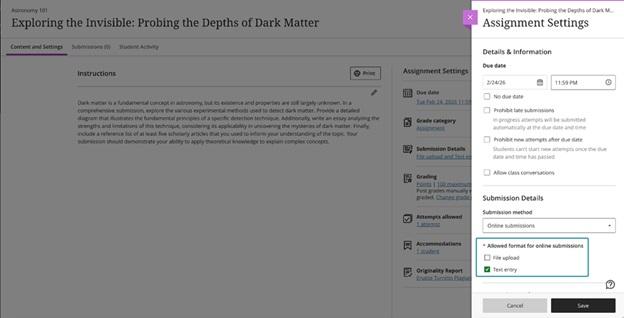
For smaller screen sizes, when an instructor sets up an assignment within a learning module, the settings panel moves from the right-hand side into the header bar. This is signified by a settings cog.

The change has been made to allow more space on the screen with the left-handed table of contents available. Users accessing that board on smaller screens, you will notice that the settings cog has moved to the header bar for that particular piece of assessment.

Set release conditions for open or started and for non-assessment content items

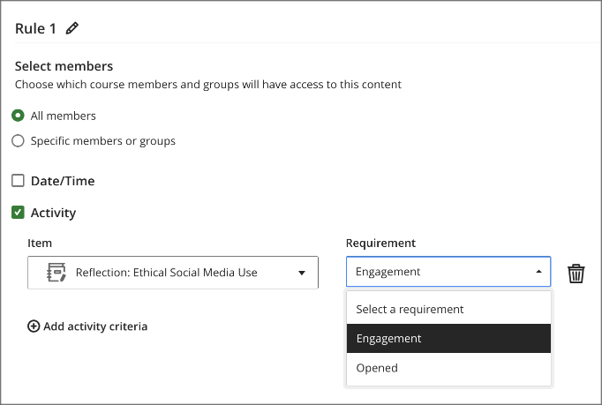
We expanded release conditions to include activity on items including non-assessment content. This enhancement allows conditions to be based on whether a student has opened or started content items such as documents, media, or course links. Instructors can now control access based on whether a student has opened or started a prerequisite content item.

Key options for release conditions:

  • Unopened: The student has not accessed the item.
  • Opened or Started: The student has accessed the item.

For example, an instructor can require students to open a reading or watch a video before an assessment becomes available. 

Improved handling of group membership changes for group assessments   

We’ve enhanced Flexible Grading and the Submissions page for group assessments to better handle changes in group memberships. These improvements ensure grading accuracy and reduce confusion when groups are modified after submissions: 

  • On the Submissions page, if all members are removed from a group:
  • The group avatar displays a ? icon.
  • No members label appears.
  • The group name becomes non-selectable.
  • For active groups, the Flexible Grading interface always shows the current group members for each attempt.

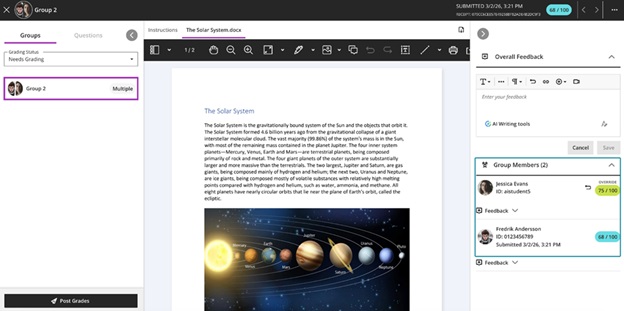
Image 1: On the Submissions page, a No Members label appears in groups with no members.

Image 2: The Flexible Grading interface shows the current group members for each attempt.

Improved Automations experience 

Back in October we launched automations – an automated messaging tool to contact students based on marks in the gradebook.

Several enhancements have been made to automations in this month’s updated:

Instructors

  • Better visibility of Automations actions
  • Users can now check the status of each automation directly from the list.
  • Each automation now displays who executed it, increasing transparency in multi-instructor courses.
  • Cleaner interface and more intuitive interactions, including:
  • Pagination on the automation list for smoother navigation.
  • Improved error messaging and validation when configuring numeric inputs.
  • Minor layout and usability improvements for the automation rules panel.
  • String and localisation improvements.

Image 1: There is an indicator of the status of each automation in the list (active or inactive). The last person to execute the action is stated under each automation, and an error message is displayed for an automation that is incorrectly configured.

If you have any enhancements to request from Blackboard, please get in touch with us via elearning@aber.ac.uk.

What’s new in Blackboard June 2025

In the June update, we are particularly excited about a new question type: jumbled sentence.

There are enhancements to Discussions, Knowledge Checks (Documents), and Student Activity Logs that we would like to draw your attention to.  

New: Question type: Jumbled Sentence

This question type has been highly requested since our move to Blackboard Ultra, so we are pleased to see it available.

Jumbled Sentence is now an option in the Question Type dropdown. This question type is also available for the AI Design Assistant as well.

To create a jumbled sentence question:

  1. Select Add Jumbled Sentence question in the question creation canvas:
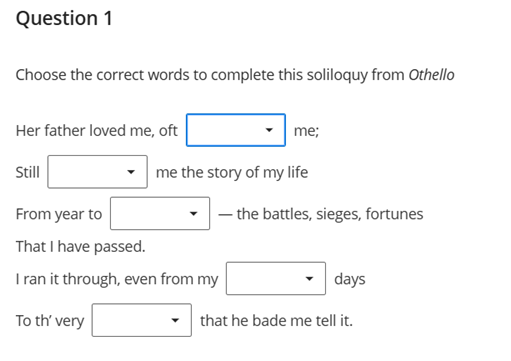
image showing Jumbled Sentence question

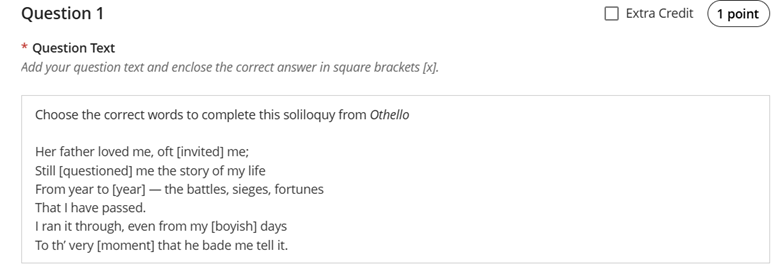
  • Enter your question text putting the gap and correct answer in square brackets:
image showing Jumbled Sentence editor window

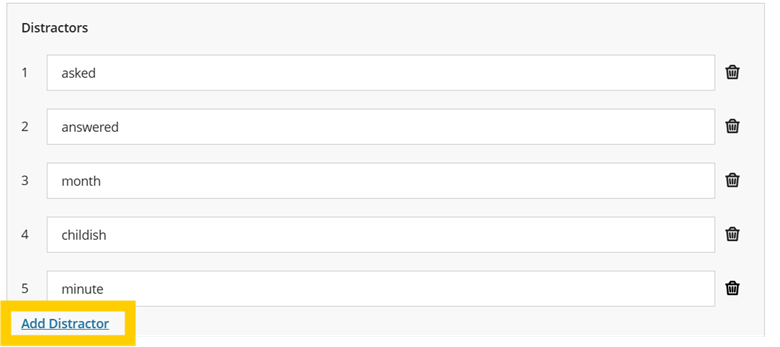
  • Enter distractors which also appear in the dropdown for students to complete the question:
image showing distractor options

  • Save your question and deploy your test as usual.

The above question will display to students like this:

image of the Jumbled Sentence question from a students’ perspective

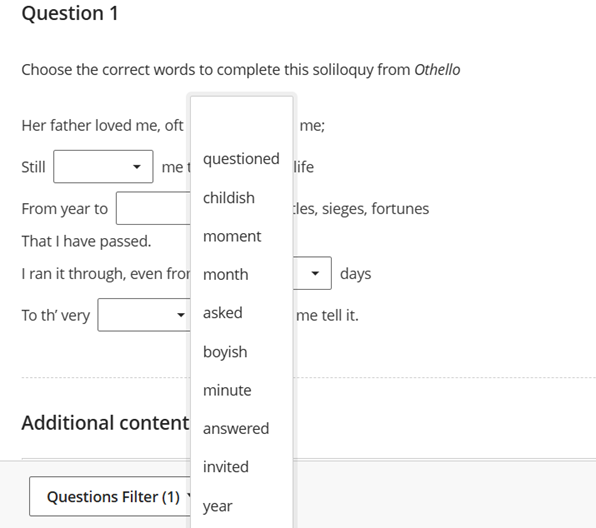
With students clicking on the dropdown to select the correct work which includes all correct answers and any distractors you might have added:

image showing Jumbled Sentence options from dropdown menu

Enhance student engagement with unread discussion activity indicator

Blackboard  improved the discussion experience by adding another indicator of activity. This addition encourages student engagement and makes it easier for instructors to track student activity. 

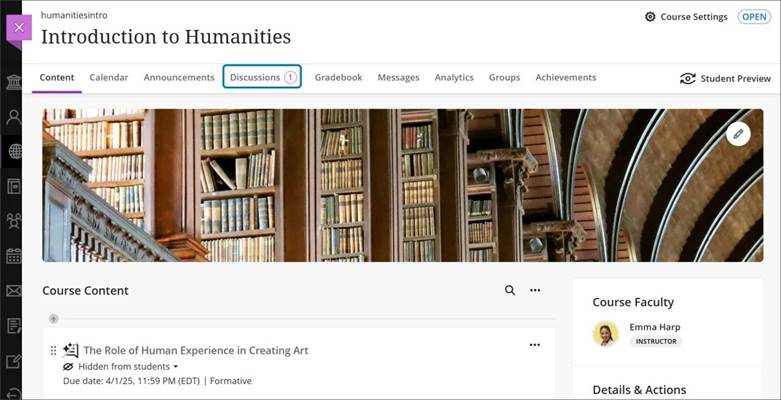
  • Unread Discussion Posts: The Discussions page now shows the number of unread discussion posts from anywhere in a course. 

Image 1. From the Course Content page, the link to the Discussions page now has a number beside it that indicates the number of new discussion posts.

Enhanced overall appearance and usability of Knowledge Checks in Documents

Last September’s release saw the introduction of Knowledge Checks to Documents.

These are a great way to assess students’ knowledge and understanding, whilst also acting as a way to maintain engagement with their Virtual Learning Environment.

The changes include:

Instructors and students 

  • Answer Choices: The letters of answer choices now display at the top of each answer option, rather than in the middle.
  • Answer Labels: Correct and incorrect answer labels have been moved from the side of an answer option to the top.
  • Question Text Padding: Padding on the right side of question text that extended past the answer text has been removed.
  • Small Screen Adjustments: On very small screens, the “Correct answer” label is now shortened to “Correct.” 

Instructors 

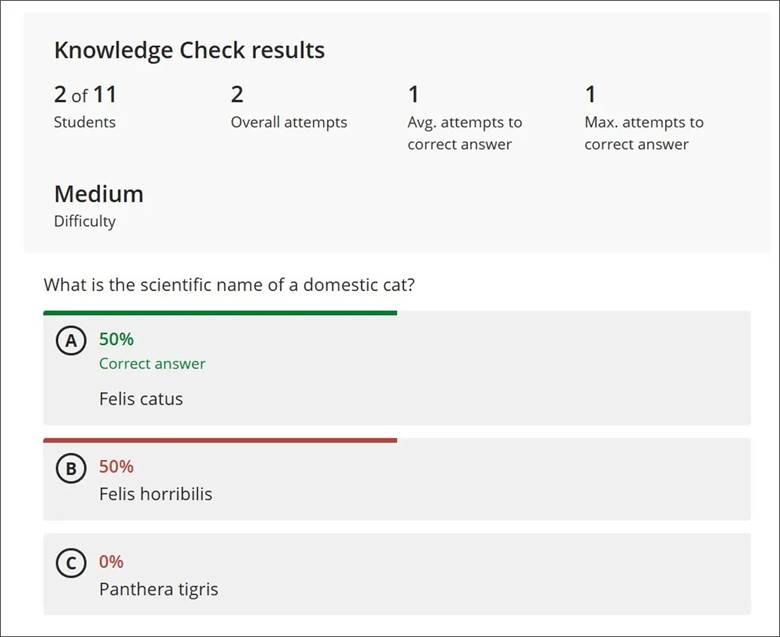
  • Answer Metrics: Answer metrics now appear at the top of answer text alongside the correct and incorrect answer labels.
  • Visual Indicators: Instead of highlighting questions with red and green to indicate the correctness of the answer, a bar now appears at the top of a question.
  • Result Labels: Result labels are now displayed in lowercase instead of all capital letters.
  • Small Screen Padding: Padding to the left and right of the Knowledge Check results has been removed for smaller screens.
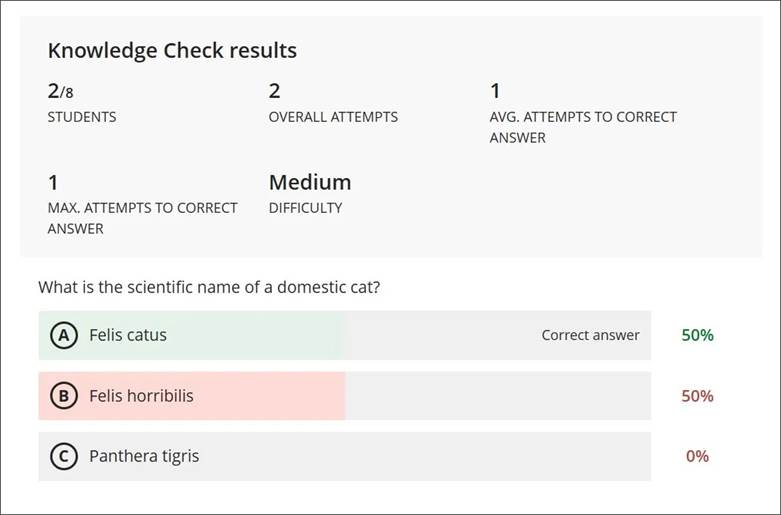
  • Participation Count: The number of students who participated is no longer shown as a fraction. Instead, students are described as part of a number. For example, “2 of 8 students participated.” 

Image 1. The instructor view of Knowledge Check results in 3900.116.

Image 2. The instructor view of Knowledge Check results in 3900.118.

Students 

We made several changes to enhance the mobile and small screen experience for students. 

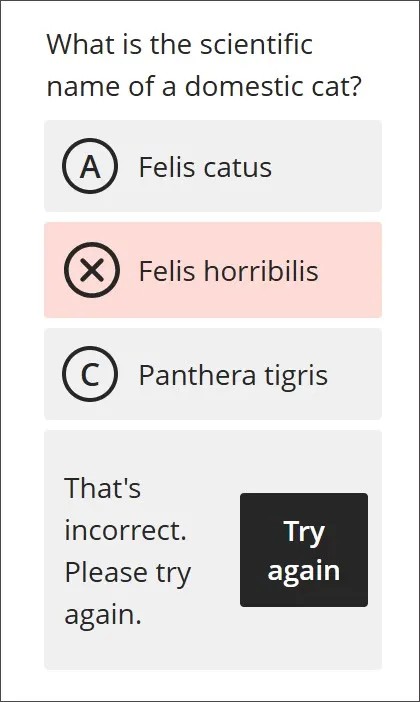
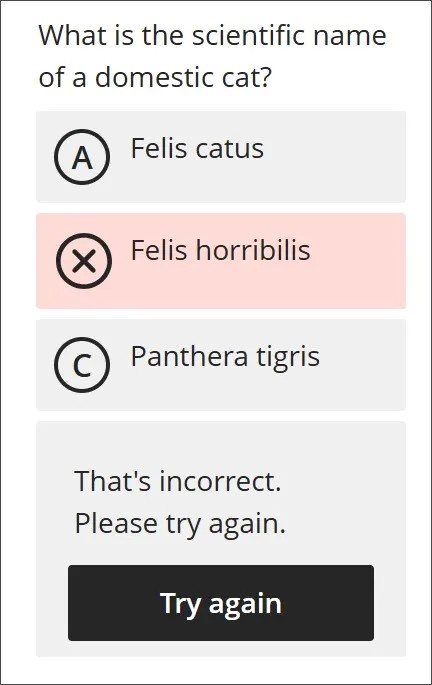
  • Submit Button: The Submit button now occupies the entire space at the bottom of a question, rather than just partial space on the right.
  • Feedback Layout: For correct answers, the checkmark indicator, correct answer feedback, and Reset button now stack vertically instead of being on a single row. This change also applies to incorrect answer feedback and the Try again button.
  • Answer Selection Indicator: On all screens, the answer a student selects now has a purple line to indicate it has been chosen. 

Image 3. The student view of an incorrect answer in a Knowledge Check in 3900.116.

Image 4. The student view of an incorrect answer in a Knowledge Check in 3900.118.

Student Activity Log

Blackboard added two new features to the Student Activity Log to enhance tracking and reviewing student engagement. These updates streamline the evaluation process and provide more comprehensive data for instructors. 

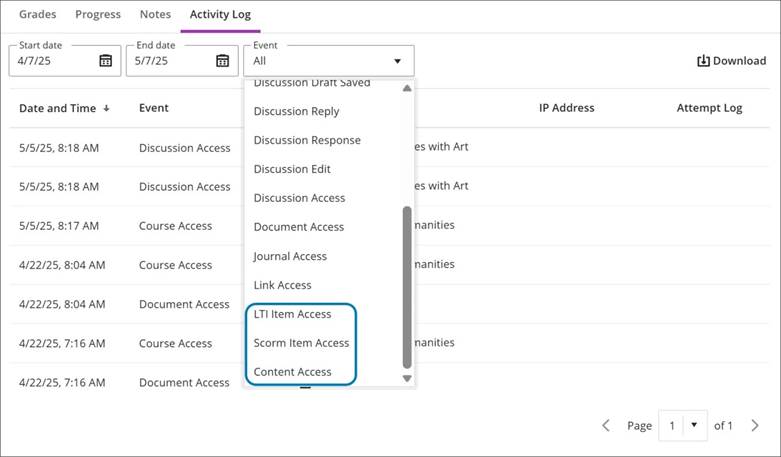
  • Content Access Filter: The Student Activity Log now includes a filter for content access, recording information not available elsewhere, such as Kaltura content. This allows instructors to easily review students’ access without needing to download and manually filter CSV files, saving time and simplifying the process.
  • Enhanced LTI Access Filter: The LTI access filter now includes all types of LTI items, including LTI placeholders. This provides instructors with more detailed insights into how students interact with LTI elements in their courses.

Image 1. The Content Access and LTI Access filters are in the Event menu.

If you have any enhancements to request from Blackboard, please get in touch with us via elearning@aber.ac.uk.

What’s new in Blackboard March 2025

What’s new in Blackboard March 2025

In the March update, Blackboard has changed how release conditions work with due dates and included the ability to copy banners from one course to another. Other updates include enhancements to Tests, Assignments, & Gradebook, and Discussions.

Release conditions panel: due dates now included

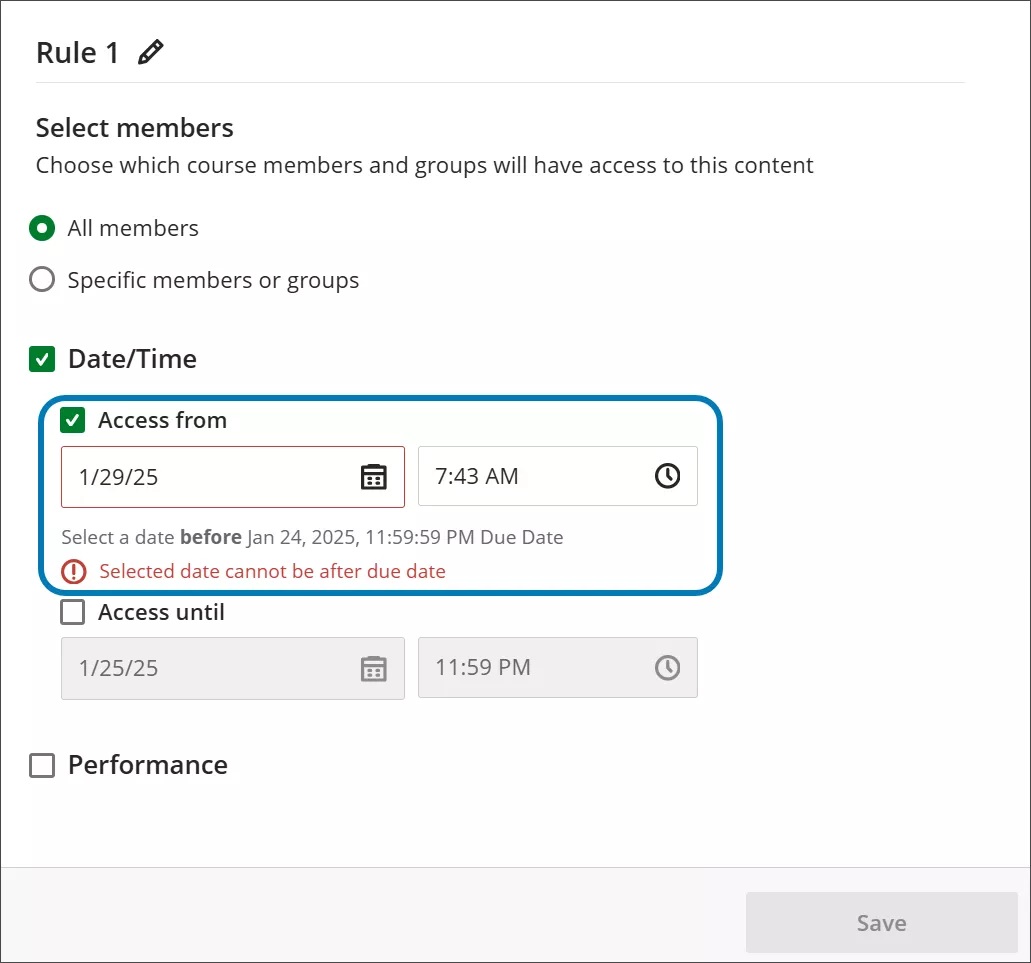
When instructors customise release conditions for a content item, the due date for the item is now included with the date and time fields.

Image 1: The due date of a content item now displays after the date and time fields

The due date of a content item now displays after the date and time fields

.Release condition rules, with the date/time section highlighted to show the red warning text about dates

This means that due dates must be between the release conditions of Date/Time that have been applied.

Copy banners between courses

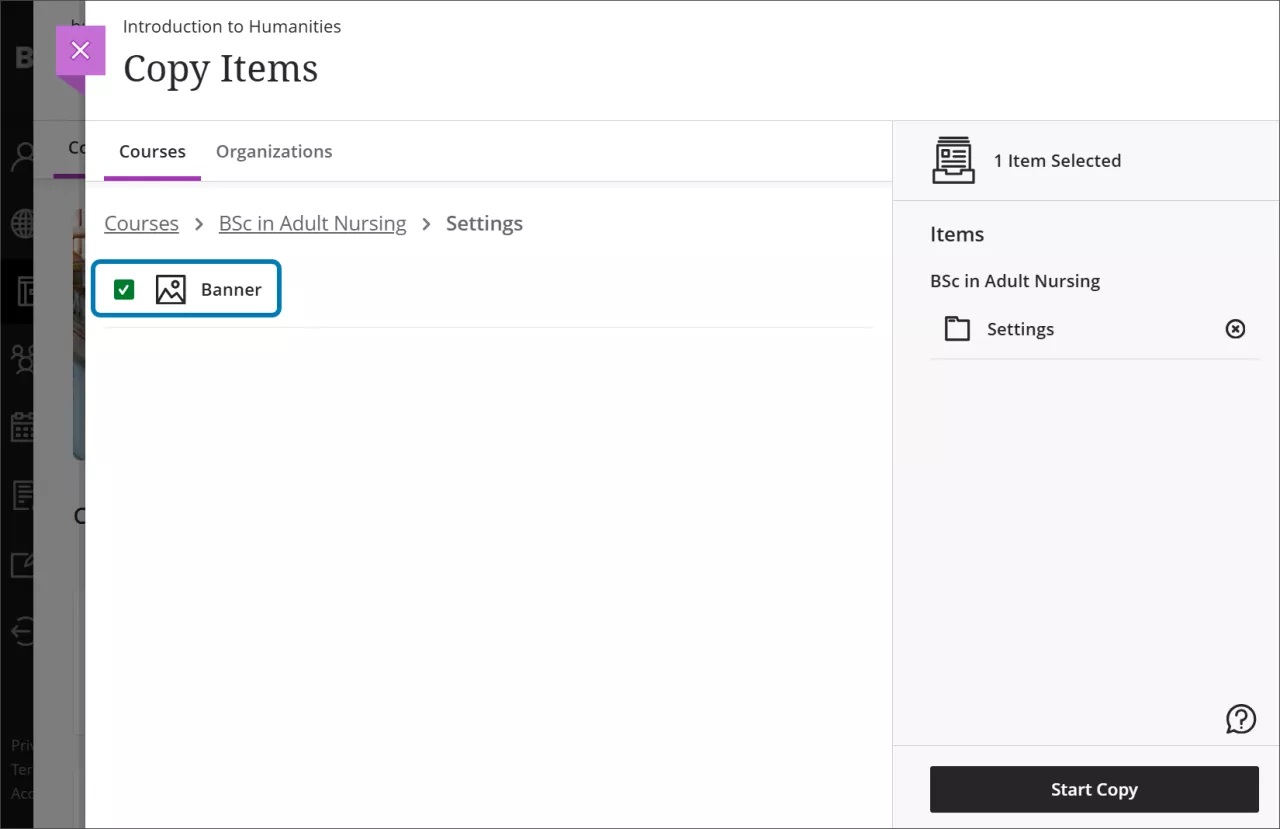
Instructors now have the option to copy banners between courses. Banners can be copied from Ultra or Original courses. 

Image 1: The Copy Items page now has the option to select the course banner under Settings

The Copy Items page now has the option to select the course banner under Settings

Follow the instructions on copying content for further information.

Tests, Assignments, and Gradebook

The following enhancements are grouped under tests, assignment, and gradebook activities.

New student submission review page for tests

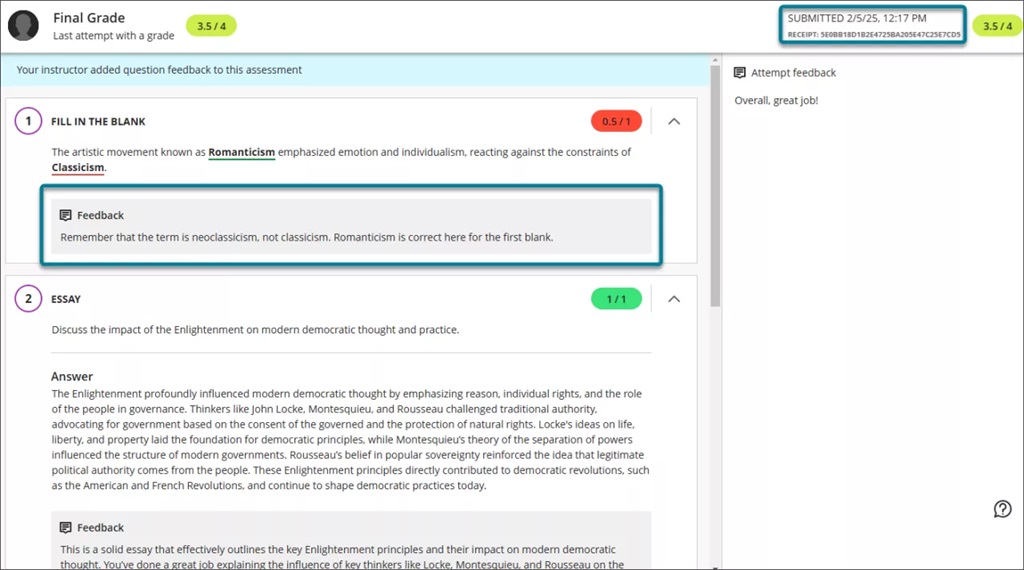
A new and enhanced student-facing submission review page for tests has been developed.

The new layout means that all feedback is clearly laid out and easy for students to identify.

Image 1: The student view of the graded test submission includes a submission timestamp, submission receipt, and feedback for individual questions.

The student view of the graded test submission includes a submission timestamp, submission receipt, and feedback for individual questions.

If the test is visible and feedback has been posted, students can access the review page from:

  • The gradebook feedback button for the test
  • The small panel that displays when students access a test from the Course Content page

If a student submits multiple attempts, they can review each attempt on the submission review page. The instructor defines which attempt to grade in the test’s final grade calculation setting.

Please note that this does not affect online exams as we advise that the test is hidden from students to prevent them seeing their results.

Show/hide calculated columns in the gradebook

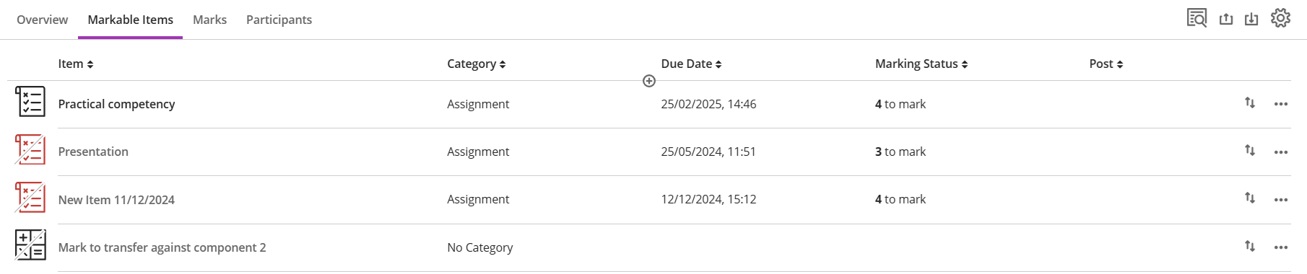
Instructors can now configure visibility for calculated columns from Items Management in the Gradebook by click on the associated calculation:

Image showing markable items in the Gradebook

Pop-out rubric with Blackboard Assignment

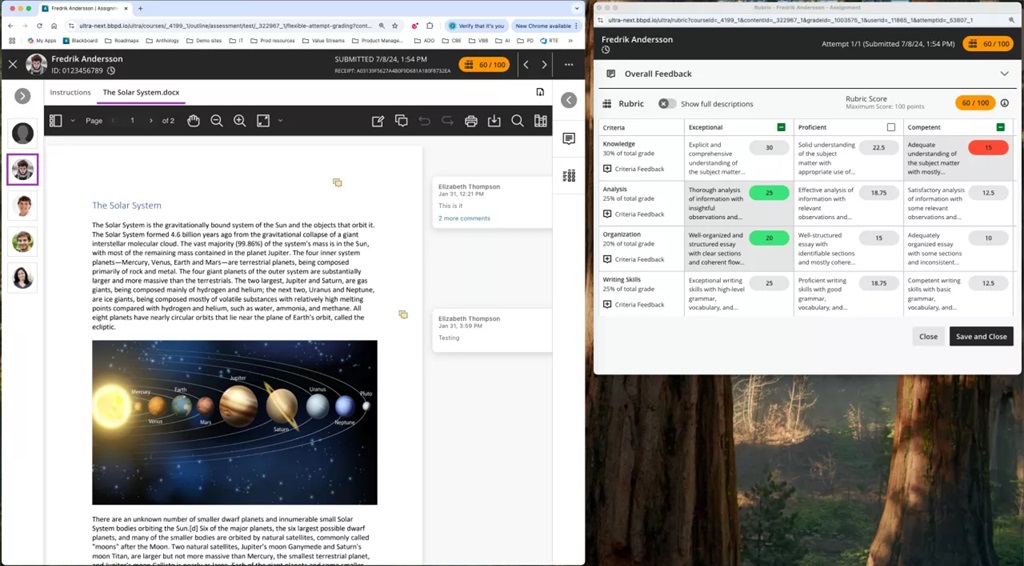
Grading rubrics on Blackboard Assignments can pop out into a separate window as part of the assignment workflow.

Image 1: Instructors can pop out the rubric by selecting the expand icon in the rubric panel.

Instructors can pop out the rubric by selecting the expand icon in the rubric panel.

When the pop-out rubric is open, the ability to add Overall Feedback and grade with the rubric in the main grading interface is inactive. This prevents an instructor from editing the same information in two separate places simultaneously.

We recommend using two screens with this enhancement.

Discussions

Usability improvements for Discussions

Several improvements have been made to Discussions:

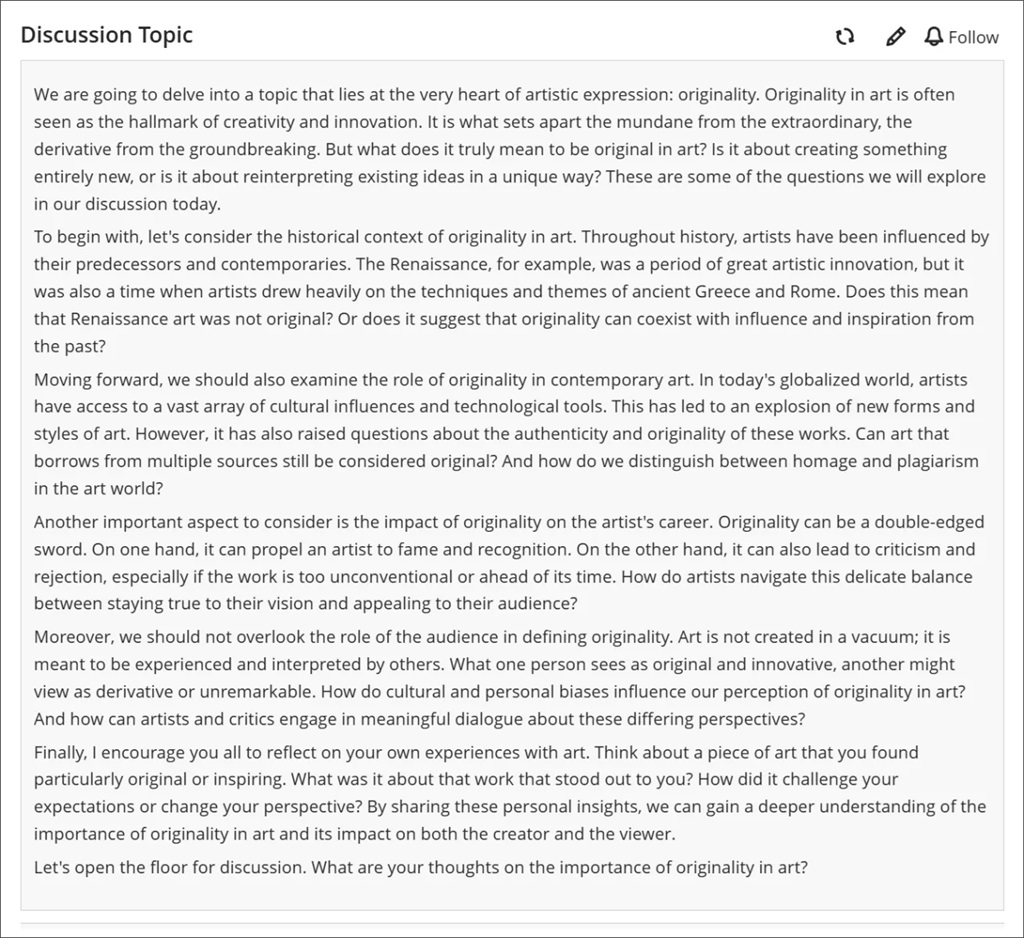
  • Improved visibility: Posts now have a grey background to stand out better against the page.
  • Full post display: Long discussion posts are now fully visible without the need for scrolling, enhancing readability.

Image 1. A long discussion post displayed in its entirety with a grey background.

A long discussion post displayed in its entirety with a grey background.

We made several changes to enhance the accessibility of key features on the discussion home page.

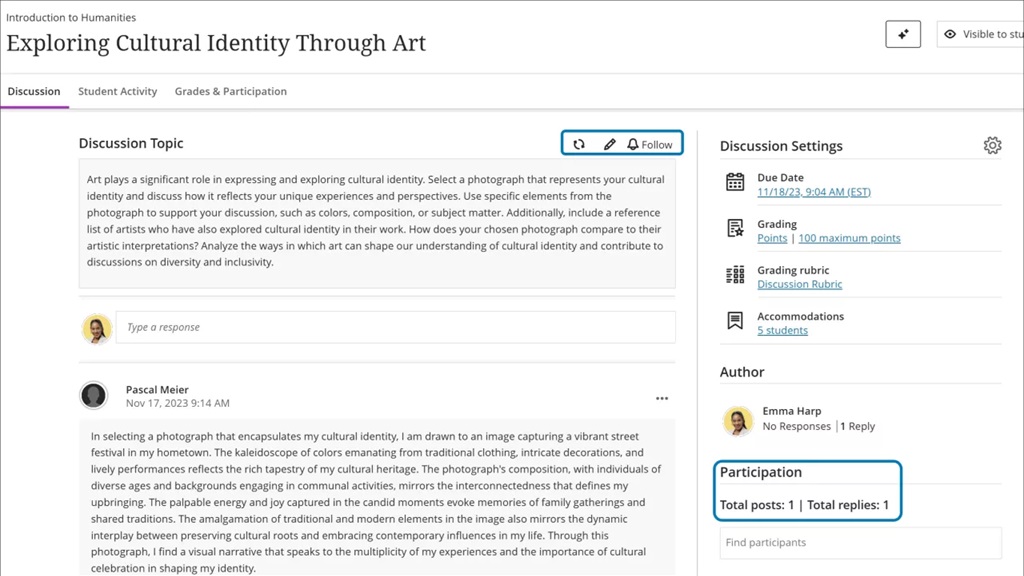
  • Participation metrics: The number of posts and replies is now listed directly on the discussion home page, replacing the total response counter. This change makes important information more immediately available.
  • Direct edit option: The Edit button is now directly accessible from the post, saving instructors time.

Image 2. The changes made to the discussion home page included the addition of an Edit button and a count of posts and replies.
The changes made to the discussion home page included the addition of an Edit button and a count of posts and replies.
Hidden Discussions tab from student course view

The Discussions page will only be available to students if any of the below conditions are met:

  • Students have permission to create new discussions
  • The instructor has created a discussion or discussion folder on the course

Anonymous discussions: New privilege to reveal author

System administrators can now reveal the identity of the author of an anonymous discussion post or reply. If you are running an anonymous Discussion and need to de-anonymise a comment, contact elearning@aber.ac.uk outlining the course, discussion, and post, as well as the rationale for requesting it be de-anonymised.

If you have any enhancements to request from Blackboard, please get in touch with us via elearning@aber.ac.uk.

Blackboard Tools for Group Work (Blogpost 4): Discussions

Group Work Banner

Blackboard Discussions for Instructors

https://help.blackboard.com/Learn/Instructor/Interact/Discussions

Online discussions provide unique benefits. Because students can take time to ponder before they post ideas, you may see more thoughtful conversations play out. You can observe as students demonstrate their grasp of the material and correct misconceptions. You can extend your office hours and reach students more often during the week so that learning is continuous.
Building a sense of community among students is crucial for a successful online experience. With online discussions, course members can replicate the robust discussions that take place in the traditional classroom.

For smaller course groups, you can also offer group discussions, available only to the members of the group.

Blackboard Discussions for Students

https://help.blackboard.com/Learn/Student/Interact/Discussions

In discussions, you can share thoughts and ideas about class materials. In Blackboard Learn, course members can have the thoughtful discussions that take place in the traditional classroom, but with the advantages of asynchronous communication. Participants don’t need to be in the same location or time zone, and you can take the time to consider your responses carefully.

You can use discussions for these tasks:

  • Meet with your peers for collaboration and social interaction.
  • Pose questions about homework assignments, readings, and course content.
  • Demonstrate your understanding or application of course material.

See our Aberystwyth FAQs on Discussions:

faqs.aber.ac.uk and search “Discussion”