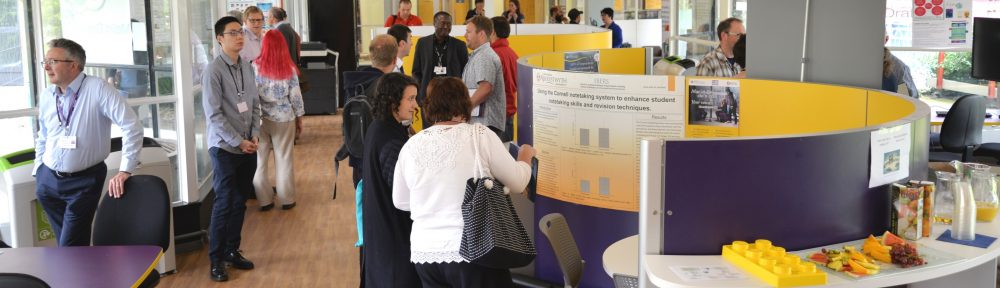
We are pleased to announce that our first external speaker joining us at this year’s Mini Conference, Using Polling Software for Learning and Teaching Activities, is Dr Christina Stanley.
Dr Stanley’s session will be entitled Polling to Boost Student Confidence and Promote Inclusivity.
Dr Stanley is a Senior Lecturer in Animal Behaviour and Welfare and is MSc Programme Lead and the University of Chester.
As leader of our PGCTHE programme, I keep an eye out for resources to help staff teach effectively. These include webinars, podcasts, online toolkits, publications and more. Topics include active learning, online/blended teaching, accessibility/inclusion, and effective learning design based on cognitive science. Below I’ve listed items that came to my attention in the past week. In the interest of clarity, our policy is to show the titles and descriptions in the language of delivery.
4-5/11/2021 AdvanceHE, Assessment and Feedback Symposium 2021: Putting the Student at the Heart of Assessment and Feedback: Equality, Diversity and Partnership
Bunbury, S., Davies, M., Jones, M., Krajewska, A., Popoola, O., Waddington, L., & Revell, L. (2021), Contract cheating detection for markers: checklist, London and South East Academic Integrity Network
Please see the Staff Training booking page for training offered by the LTEU and other Aberystwyth University staff. I hope you find this weekly resource roundup useful. If you have questions or suggestions, please contact our team at lteu@aber.ac.uk. You may also wish to follow my Twitter feed, Mary Jacob L&T.
The Learning and Teaching Enhancement Unit are excited to announce the date for the 10th Annual Learning and Teaching Conference. The conference will be taking place between Monday 12th September and Wednesday 14th September 2022.
Look out for Calls for Proposals and the announcement of the conference theme. As usual, we will be updating our Learning and Teaching Conference Webpages and also our blog to keep you up-to-date with how things are progressing.
We also have a Conference Steering Group who help with the organisation, design, and publicity of the conference. The Steering Group meets a couple of times a year. If you want to join the Steering Group for next year’s conference, then please email lteu@aber.ac.uk.
Not to worry. Vevox run regular online webinars, so if you’ve not used our new polling software before and want a great beginner’s guide, sign up to their online webinar Zero to Hero (in 15 minutes!). Running on Tuesday afternoons through to the end of November.
We’ve also got our guides and FAQs available on our Vevox webpages.
As leader of our PGCTHE programme, I keep an eye out for resources to help staff teach effectively. These include webinars, podcasts, online toolkits, publications and more. Topics include active learning, online/blended teaching, accessibility/inclusion, and effective learning design based on cognitive science. Below I’ve listed items that came to my attention in the past week. In the interest of clarity, our policy is to show the titles and descriptions in the language of delivery.
4-5/11/2021 AdvanceHE, Assessment and Feedback Symposium 2021: Putting the Student at the Heart of Assessment and Feedback: Equality, Diversity and Partnership
Abegglen, S., Aparicio-Ting, F. E., Arcellana-Panlilio, M., Behjat, L., Brown, B., Clancy, T. L., DesJardine, P., Din, C., Dyjur, P., Ferreira, C., Hughson, E. A., Kassan, A., Klinke, C., Kurz, E., Neuhaus, F., Pletnyova, G., Paul, R. M., Peschl, H., Peschl, R., & Squance, R. T. (2021). Incorporating Universal Design for Learning in Disciplinary Contexts in Higher Education (M. Arcellana-Panlilio and P. Dyjur, Eds.). Calgary, AB: Taylor Institute for Teaching and Learning Guide Series.
Carbon, M. B. (6/10/2021), The active essay writing initiative, University of Essex School of Psychology blog, featuring 2-minute video by Wendy Garnham
Please see the Staff Training booking page for training offered by the LTEU and other Aberystwyth University staff. I hope you find this weekly resource roundup useful. If you have questions or suggestions, please contact our team at lteu@aber.ac.uk. You may also wish to follow my Twitter feed, Mary Jacob L&T.
The Learning and Teaching Enhancement Unit is pleased to announce that it’s next Mini Conference will be taking place on Thursday 16th December, online via Teams.
We’ll be taking a look at polling software – a tool that can be used to engage students in their learning and drive-up understanding of complex topics. This year, the University procured Vevox, an online polling tool, that is fully integrated in Teams and can make your face to face activities interactive.
Call for Proposals:
We’re looking for colleagues that make use of polling software in their learning and teaching to present at the Mini Conference. Potential topics might include:
Using polling for induction and ice-breaker activities
As the start of term kicks off, we’d like to invite you to the forthcoming Academy Forums over the next academic year. Our academy forums take place around a particular topic or theme relevant to learning and teaching. They’re an informal space to reflect on and share teaching practice, build connections with colleagues from other disciplines, and keep up to date with debates in the HE sector.
Based on feedback from our successful sessions last year, we’ve extended our Academy Forums to 90 minutes.
Our first session is taking place on 2nd November, 11am-12.30pm. In this session, we’ll be taking a look at the results from the Digital Insights survey. The survey is run by JISC and asks students about their digital learning experiences. For the academic 2020-21, we had over a thousand responses. Come along to this session if you want to hear about the findings and also think about ways in which you can build the results into your digital teaching.
Second up, on the 2nd December (10am-11.30am), we’ll be thinking about designing blended learning. Over the past eighteen months, colleagues have delivered purely online, purely face to face, and also Hyflex teaching activities for students. If you want to consider how to blend the online teaching activities with in person teaching activities, then come along to this session. You’ll be able to reflect on the resources that you’ve produced and how you might go about tweaking them for the current teaching context.
Following the winter vacation period, our third Academy Forum session will be taking place on 10th February (10am-11.30am). This session will take a look at strategies for designing authentic assessments. JISC outline, in their paper The Future of Assessment: five principles, five targets for 2025, that one of the key tenets of assessment design is to make it authentic. Participants will be given the opportunity to enhance an existing assessment or design a new one from scratch.
Into spring now, and our fourth Academy Forum of the year will be looking at peer feedback opportunities. Students develop greater cognitive processing through being given the opportunity to work with their peers – from paraphrasing complex theories, through to sensitively critiquing other students’ work, peer feedback activities can be used to great effect. This Academy Forum will be taking place on the 3rd March, 11am-12.30am.
Our final academy forum will be looking at Students as Partners on 27th April, 11am-12.30pm. There are different approaches that can be used for Students as Partners projects. We’ll be looking at these – from student co-design to enhancement projects. In LTEU, we’ve worked on a number of student as partners initiatives and will be sharing our projects as well as giving you opportunities to establish you own project at session, module, course, or departmental level.
For now, our Academy Forums will be taking place online. Book your place on our Course Booking site. Hope to see you there.
Written by Caroline White, Student Support (caw49@aber.ac.uk)
It is thought that around 16% of the population are dyslexic thinkers. Currently, around 500 students studying at Aberystwyth University have disclosed a Specific Learning Difference, such as Dyslexia. Other students hope to forget the negative experiences associated with the “dyslexic” label or cannot afford the assessment process and so do not engage with Study Skill (Student) Support.
Some dyslexics struggle through school and then thrive in university and win dissertation prizes. Other dyslexic thinkers’ strategies work until their environment changes eg weekly reading loads significantly increase. The issues usually arise when there is a significant mismatch between the presentation of the learning material and the individual’s ways of learning.
Dyslexic skills underpin much academic work. Areas in which many dyslexic thinkers have been found to be above average are: visualising, imagining, communicating, reasoning, connecting and exploring. The risk is that these strengths are missed when written communication is used to find out what someone understands.
3 key recommendations for inclusive teaching and supporting dyslexic learners:
Be Specific – students can then use their energy to work more efficiently and experience less anxiety
Be Transparent – so that students understand the processes of developing academic skills
Be Mindful – as our students’ experiences are so varied, including the impact of the Covid pandemic
British Dyslexia Association https://www.bdadyslexia.org.uk/dyslexia. Includes free BDA online training course – dyslexia and mental health – during Dyslexia Week
As leader of our PGCTHE programme, I keep an eye out for resources to help staff teach effectively. These include webinars, podcasts, online toolkits, publications and more. Topics include active learning, online/blended teaching, accessibility/inclusion, and effective learning design based on cognitive science. Below I’ve listed items that came to my attention in the past week. In the interest of clarity, our policy is to show the titles and descriptions in the language of delivery.
20-21/10/2021 QAA, Quality Matters 2021 “Quality Matters is an annual student-focused event providing an introduction to student engagement in quality assurance and enhancement and preparing student representatives for the year ahead”
Vines, C. (23/9/2021), altc21 Resources Openly Accessible, Association for Learning Technology Annual Conference, “The full recorded online programme and session recordings are now available openly to all.”
Please see the Staff Training booking page for training offered by the LTEU and other Aberystwyth University staff. I hope you find this weekly resource roundup useful. If you have questions or suggestions, please contact our team at lteu@aber.ac.uk. You may also wish to follow my Twitter feed, Mary Jacob L&T.
In this blogpost we’ll take a look at how technology can be used to give students the opportunity to feedback thoughts and ideas or work virtually in synchronous groups. Given that students are encouraged to face the same direction in teaching rooms, group work will be a particular challenge in teaching rooms.
We recommend that you encourage students to bring their own devices. This will give you more options to build up that group discussion. If your students don’t have access to a device, then direct them to is@aber.ac.uk. If you want students to use their own devices, let them know in advance.
Use Vevox for students to feed back the summary of their discussions
Vevox is a polling tool. Here are some learning activities you might consider, or devise your own:
Individual think and share – Give students a short brainstorming or problem-solving task, ask them to think for a minute or two and then use Vevox to share their ideas. This works well in the classroom, online, or in a HyFlex environment.
Muddiest point or key takeaways – At the end of lecture, ask students to post either their muddiest point or their key take-aways from lecture. If you use take-aways, this not only gives you useful information about how well they understood the content, but also reinforces students’ learning through retrieval practice. Good for teachers and students!
Group discussion and feedback – If you are using groups of six where students manage to discuss a question while facing forward (yes, we know this is a challenge!), you can have each group report their headline messages through Vevox for the whole class to see. This allows you to consolidate the learning from all groups during class time.
Pre- and post-teaching check of understanding – Students learn best if they can link new information to prior knowledge. Ask students questions at the start of lecture to activate that knowledge, and then ask questions at the end to consolidate it. This can help students to recognise how much they have learned from the lecture while reinforcing their learning.