
Webinar: Instilling Self-Regulation in Learners & Using Sway for Online Learning

Academy Showcase is a space for sharing good practise among staff from Aberystwyth, Bangor and other Higher Education institutions. Every year we run two sessions with two presentations each, one from Aber and one from Bangor. Anybody can join Academy Showcase from their own machines using the link available here

We look forward this year’s presentations and we hope some of you will be able to join us.


20 March 2019 at 1pm -2pm

Instilling Self-Regulation in Learners by Dr Simon Payne (Aberystwyth)

We asked AU students and staff questions such as, “Why do students underachieve or even drop out?,” “What distractions do students face that interfere with their best intentions to study and improve?,” and “What happens to ‘turn students off’ from learning and striving to achieve?” The answers were remarkably similar from both groups, suggesting agreement on the problem and potential alignment on solutions. Self-regulation is the voluntary control of impulses which can facilitate or hinder us from achieving our goals. Hence, self-regulation includes the ability to regulate cognitive processes and activities, e.g. to plan, monitor and reflect on problem solving activities. Self-regulation also includes the control of one’s competing/conflicting motivational and emotional impulses and processes, e.g., overcoming social anxiety to contribute in class. Clearly, the development of self-regulation skills will help students achieve their objectives for entering HE. This presentation will provide techniques for tutors to help their students and tutees to be better self-regulators, and introduce and rationalise an ambitious AU-wide programme of studies that target student self-regulation ability.


Using Sway for Online Learning by Helen Munro (Bangor)

Sessions will be provided in English.
 

Polling software: Mentimeter and Poll Everywhere

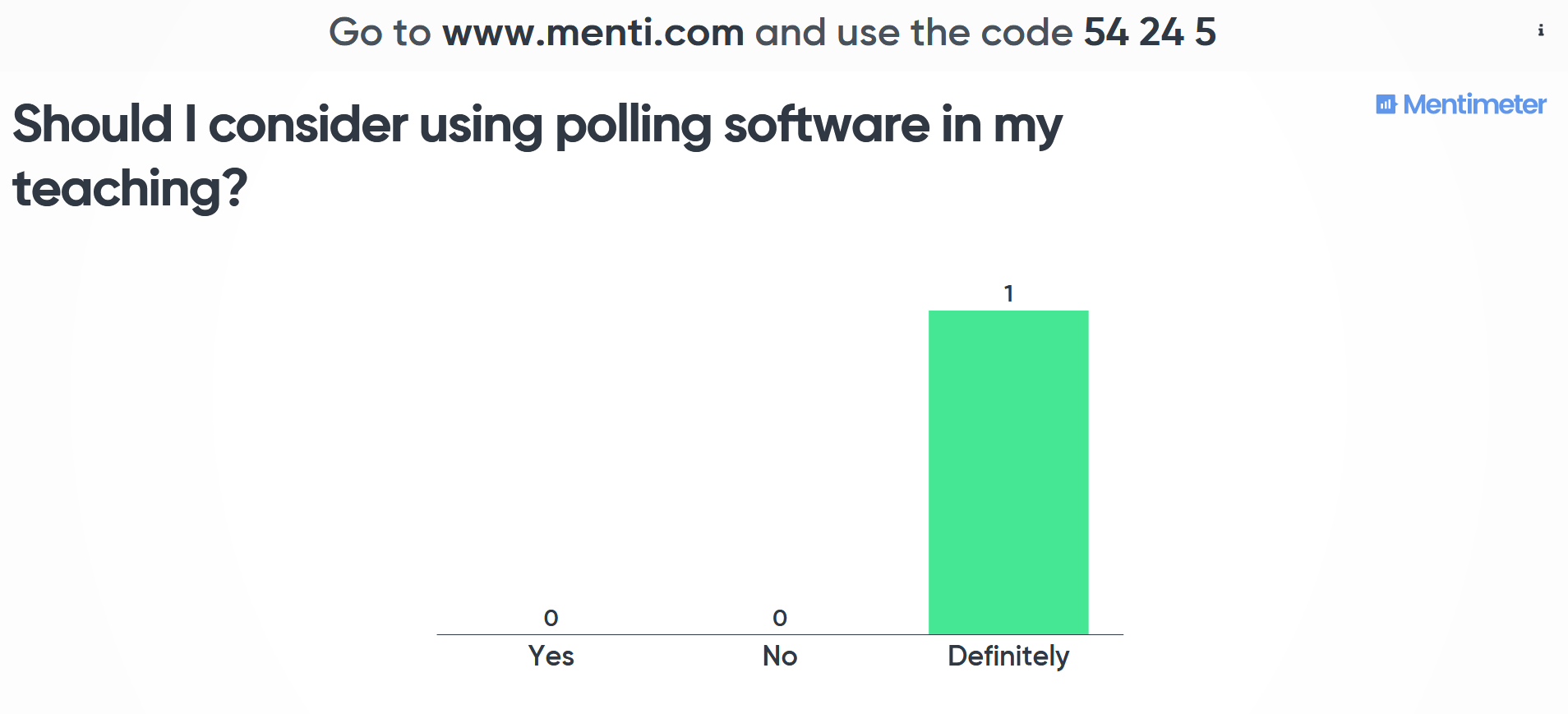
The E-leaning Group is looking into how polling software can be used in lectures and seminars. Polling software is a great way to increase classroom engagement as it provides interactive presentations ranging from multiple choice questions to live word clouds. With their personal devices (such as mobiles, tablets etc.), students will be able to answer questions, vote and ask queries,which will appear on the presentation slides.  The recent Digital Insights survey, overseen by Information Services, showed that fifty-seven percent of lectures already use some sort of polling software in the classroom.

Some examples of positive comments from students include:

 “Provided quick feedback on what lecture we needed help with”

“Online poll, on parts of the subject asking the class how much they understood. This made it so people put how they actually felt as they didn’t have to speak in class”

“Polls in lecturers keep the students interested”

“It was fun last year when we did online quizzes in the lecture, interactive with each other and then went through the answers question by question on the big screen”

“Method of reviewing prescribed reading material”

The E-Learning Group has found Mentimeter and Poll Everywhere to be especially accessible and reliable:

  • Mentimeter is best used for lectures with larger audiences as it has no limit on participants. With Mentimeter you can create: quick slides, questions and quizzes. There is no limit on the number of quick slides, however with the free version you only be able to create two questions and five quizzes.
  • Poll Everywhere caps its audience at twenty-five so can best work in seminars and workshops. Poll Everywhere provides much of what Mentimeter does with the benefit of having no limit on the number of questions/activities.

There is a guide to creating presentations with both Mentimeter and Poll Everywhere available on our webpages.


Digital Experience Insights 2018-19: How do you rate technology at Aberystwyth University?

For the second time Aberystwyth is taking part in the Digital Experience Insights project aiming to explore our students’ experiences of technology. The project is based on online surveys designed by Jisc and used by different institutions across UK.

It allows us to get better insights on how students use technology and benchmark our results against other HE intuitions in our sector.

We would greatly appreciate your help in promoting this survey to all students:


Jisc Digi Tracker: findings from students in UK further and higher education

Take a look at the full report of the findings from all the institutions that participated in the 2018 Digital Experience Tracker. Many of the key messages included in the report correspond to findings from Digital Tracker at Aber.

Consistency in the VLE

We have repeatedly received feedback from students asking for VLE navigation to be more intuitive and the organization of content to be more consistent across modules. Findings from the Digital Tracker at Aber and the benchmarking data from UK emphasise this issue. Students would like all the materials for their courses to be available on the VLE in a timely manner and possibly in the same location in all modules so that they can navigate easily to the content that they need.

Engage students in class using technology

Can we use technology to make lectures more engaging? Our results in the digital course activities section of the tracker were lower than the benchmarking scores. Students have also asked for their sessions to be more interactive in the open text comments:

‘Make lectures more interactive and able to include the students to interact more. There’s an online website where you can join to get the right answer which gets people competing and learning.’

We are happy to support any members of staff who would like to enhance their teaching with digital course activities. Contact us to discuss your ideas and possibilities or come to one of our E-learning Enhanced: What can I do with Blackboard? Sessions.

Digital skills for life

Although most students use technology on a daily basis, they are not necessarily aware what these essential digital skills are and how important digital skills are for their employability. Less than a half of AU Digital Tracker respondents don’t feel that the university prepares them for the digital workplace.

You may notice that the report is called Digital Experience Insights rather than Digital Experience Tracker. The Digital Experience Tracker 2018 was a pilot study which led to a new service now called Digital Experience Insights. We believe that the participation in this project helped us to more effectively meet digital expectations’ of our students. We hope to share examples of good practise in this area on our blog.

If you wish to share your experiences of supporting students digitally as a guest blogger, please contact us: elearning@aber.ac.uk

Read:


Celebrating excellence in teaching: AU Blackboard Exemplary Course Awards (ECA)

We are proud to announce that the winners of this year’s AU Blackboard ECA awards are being presented with their awards during this week’s graduation ceremonies.

Adam Vellender, Catherine O’Hanlon, Daniel Low and Stephen Chapman, the winners 2017-2018 ECA winners are being presented with their awards during their department’s graduation ceremony. The winning modules all showed the high standard of learning and teaching at Aberystwyth University and inspire others to innovate and engage students in active learning and contained many exemplary practices. The winners’ modules contained many exemplary practices and received Highly Commended Awards.

Now in their fifth year, the Exemplary Course Awards recognise excellence in course design, interaction and collaboration, assessment and learner support. “The ECA provides an excellent opportunity for staff to share their work with other colleagues, refle~@ct on their use of tools such as Blackboard, and get feedback on their learning activities from their peers. We congratulate all our Highly Commended staff this year and encourage other staff to consider entering their modules in the future. The E-learning Group are happy to provide advice and support for any interested in finding out more about the ECA.” Kate Wright, E-Learning Group Manager

For further information see here.