In November, we took part in Blackboard Ally Fix your Content Day, making the content of our Virtual Learning Environment even more accessible. We placed 3rd in the UK and 60th on the international leaderboard.
We’re planning our next Mini Conference in collaboration with colleagues in Student Journey for April 2026. Further information will be made available soon.
And our 14th Education and Student Experience Conference will take place between 8-10 September 2026. Keep an eye out for updates, call for proposals, and external speaker announcements.
In the December update, we want to draw your attention to the following Blackboard enhancements:
Specify participation requirements for Discussions
Support Inline and Display Formulas in MathJax
Learning Module Table of Contents
Set release conditions for open or started and for non-assessment content items
Improved handling of group membership changes for group assignments
Improved Automations experience
Specify participation requirements for Discussions
Instructors now have greater flexibility when managing student participation in graded Discussions.
With this update, instructors can specify required student responses for a Discussion topic.
Instructors
Instructors can now make clear participation requirements to students. The initial release adds participation requirements to the existing due date(s) for discussions. Instructors can set requirements on the number of required posts and/or replies for a student to fulfil the requirement.
The status of participation requirements is updated through to completion, giving a student a clear understanding of progress made. Participation requirements are linked to progress tracking, so that will be accurately displayed for the student to monitor.
This update does not affect grading workflows or Gradebook structure.
Image 1: Instructors being able to set participation requirements in discussion settings.
Students
The new participation requirements in Discussions give students a clearer understanding of instructor expectations in an assigned Discussions topic. Students can monitor their progress both in the assigned Discussions topic as well as in Progress Tracking.
Image 2: Showing the complete state when all the requirements have been met.
Support Inline and Display Formulas in MathJax
MathJax support in the Content Editor now includes additional LaTeX delimiters for rendering mathematical formulas. This update improves compatibility with standard STEM workflows and simplifies uploading exam content without changing source files.
Instructors and students can now use:
\(…\) for inline equations
\[…\] for display equations
These options are in addition to the existing $ delimiters. Expanded support improves the experience of working with mathematical notation in Ultra courses and enhances visual clarity for complex expressions such as integrals, sums, and products.
Learning Module Table of Contents
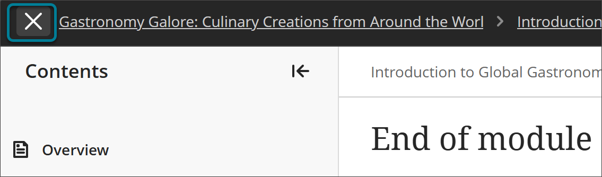
Instructors now have access to a collapsible Table of Contents panel in Learning Modules. This update mirrors the student experience and supports consistent navigation across roles.
The Table of Contents panel includes all items in a learning module. Select Contents to open or collapse the panel. Instructors can navigate the full module structure and align course design with the student experience.
Image 1: Instructor view of a Learning Module with the Table of Contents panel open.
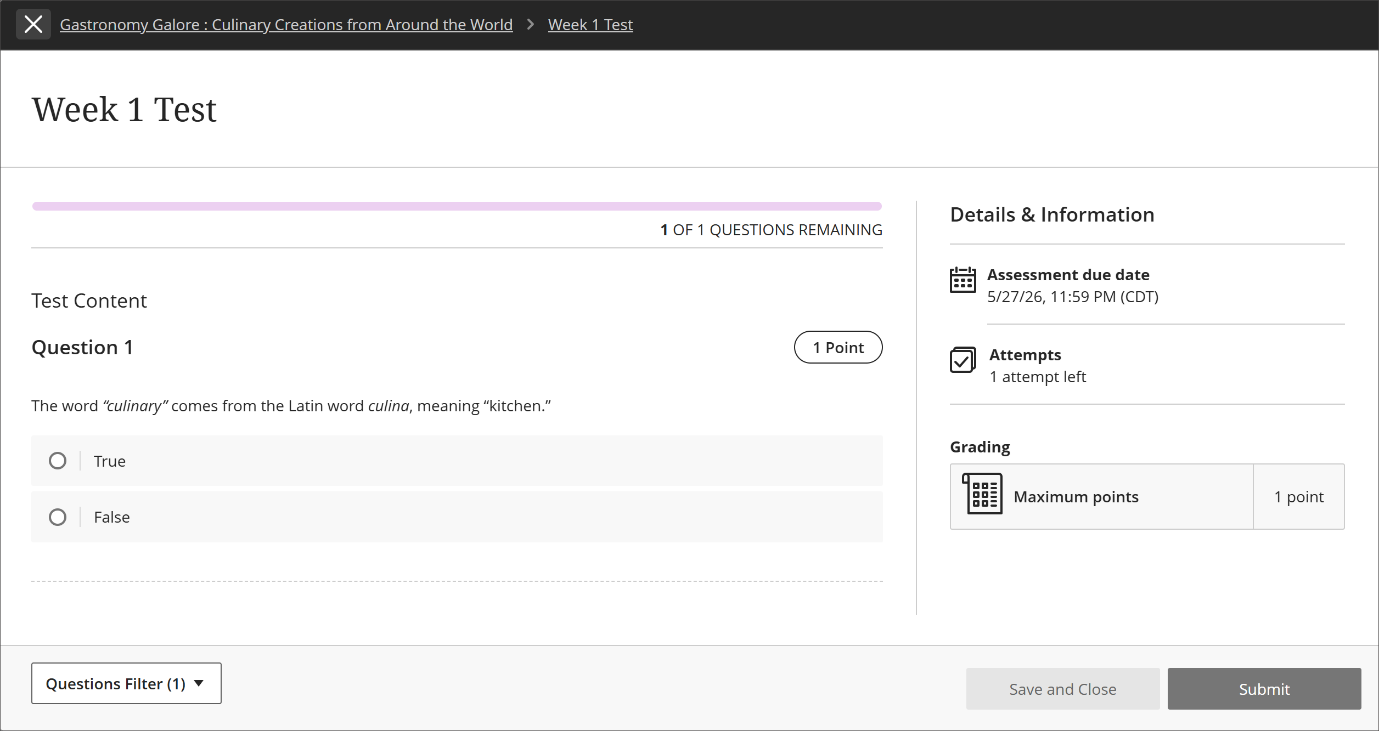
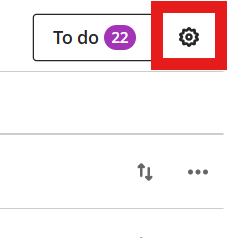
For smaller screen sizes, when an instructor sets up an assignment within a learning module, the settings panel moves from the right-hand side into the header bar. This is signified by a settings cog.
The change has been made to allow more space on the screen with the left-handed table of contents available. Users accessing that board on smaller screens, you will notice that the settings cog has moved to the header bar for that particular piece of assessment.
Set release conditions for open or started and for non-assessment content items
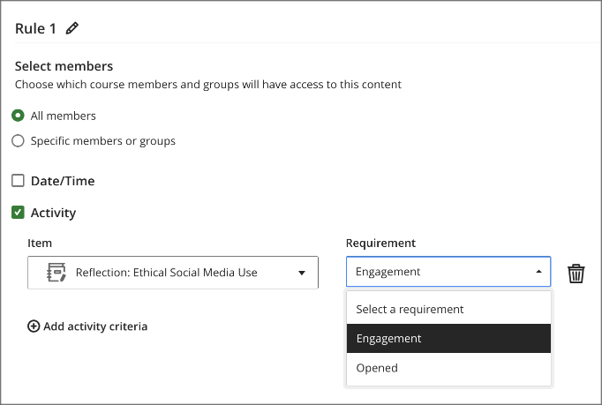
We expanded release conditions to include activity on items including non-assessment content. This enhancement allows conditions to be based on whether a student has opened or started content items such as documents, media, or course links. Instructors can now control access based on whether a student has opened or started a prerequisite content item.
Key options for release conditions:
Unopened: The student has not accessed the item.
Opened or Started: The student has accessed the item.
For example, an instructor can require students to open a reading or watch a video before an assessment becomes available.
Improved handling of group membership changes for group assessments
We’ve enhanced Flexible Grading and the Submissions page for group assessments to better handle changes in group memberships. These improvements ensure grading accuracy and reduce confusion when groups are modified after submissions:
On the Submissions page, if all members are removed from a group:
The group avatar displays a ? icon.
A No members label appears.
The group name becomes non-selectable.
For active groups, the Flexible Grading interface always shows the current group members for each attempt.
Image 1: On the Submissions page, a No Members label appears in groups with no members.
Image 2: The Flexible Grading interface shows the current group members for each attempt.
Improved Automations experience
Back in October we launched automations – an automated messaging tool to contact students based on marks in the gradebook.
Several enhancements have been made to automations in this month’s updated:
Instructors
Better visibility of Automations actions
Users can now check the status of each automation directly from the list.
Each automation now displays who executed it, increasing transparency in multi-instructor courses.
Cleaner interface and more intuitive interactions, including:
Pagination on the automation list for smoother navigation.
Improved error messaging and validation when configuring numeric inputs.
Minor layout and usability improvements for the automation rules panel.
String and localisation improvements.
Image 1: There is an indicator of the status of each automation in the list (active or inactive). The last person to execute the action is stated under each automation, and an error message is displayed for an automation that is incorrectly configured.
If you have any enhancements to request from Blackboard, please get in touch with us via elearning@aber.ac.uk.
A huge thank you to all the staff who we’re involved in Fix Your Content Day on 18th and 19th November. This was the first time that AU signed up to the Day, and we’re pleased to announce that we placed 60th in the official leader board.
120 institutions took part from across the world. There were 13 institutions from the UK and Aberystwyth placed 3rd in the UK.
AU staff made 125 changes to content through Blackboard Ally in the 24 hours of the competition. During our drop-in afternoon, we were able to provide guidance on headings and styles, font colours and contrast, as well as handwritten documents and PDFs. Each of those 125 changes make it easier for students to engage with their learning materials.
We’re also pleased to announce that the overall Ally score for 2025-26 courses on 19th November was 74.9% – an increase of 5.3% from the previous year.
The good news is that you don’t have to wait until the next Fix Your Content Day to use Ally. You can use Ally any time you like – it’s quick and easy to use for both existing and new content.
A big thanks to all staff who have taken the time to check on the accessibility of their course materials and made changes to them.
On November 18, Aberystwyth University will join institutions worldwide for Fix Your Content Day 2025, hosted by Anthology. If you are wondering about what this means, or whether to take part, then here are a few reasons to get involved.
Every change – big or small – makes a difference to our students. Making Blackboard content as accessible as possible benefits all our students. Having materials in a format that students can use easily means that they can focus on their learning rather than struggling with inaccessible formats. The choices that staff make to design accessible materials, as well as the Ally Alternative Format tools, help us to make sure that all students can engage with their studies.
It’s particularly important here at AU, as the latest HERA data show that over 28% of our students have a declared disability (compared to 16.7% nationally).
Drop-in session open to all. Although our e-learning staff are always willing to help you with accessibility, we’ll have dedicated support available in B23 Llandinam during the afternoon of 18th. Come along and we can show you how to use Ally or discuss any particular issues you have with your course materials. And tea and biscuits will be available!
And finally, taking part in Fix Your Content Day is part of our ongoing commitment to ensuring that all students can engage with learning materials.
When adding items to Blackboard, the Additional Tools item is currently labelled Content Market. Staff should use this to add Turnitin submission points or Panopto links.
Settings in Welsh (Offer Ychwangeol) are working correctly.
This is a temporary change due to issues with the Blackboard language settings.
Note that students submitting Panopto assignments should also use the Content Market link.
In the November update, we want to draw your attention to a new feature: generate and upload custom Achievements badge.
In addition to this, we have also got an automated option to generate messages to students based on their assignment scores. There is an update to tests with the functionality to bulk amend test question scores, as well as some improved navigation to Gradebook column headers.
New! Generate or upload custom Achievement Badges
Blackboard previously announced achievements – instructors having the option to award badges to students based on scores received in Gradebook columns. This was a great way to incentivise student engagement, and we are seeing more colleagues use this: DLS are piloting badges as part of their Skills Passport, and Library and Learning Services are making use of Achievements for the AI Literacy Course. Colleagues have requested this enhancement, so we are pleased to see this available on Blackboard.
Instructors now have three new options for customising Achievement badge: AI-generated images, choose from a selection of stock images from Unsplash, and manual image uploads.
AI Badge Image Creator: Instructors can enter keywords to generate badge images using the AI Design Assistant. The system auto-generates an image based on the badge’s name and description to help guide image creation. Additionally, instructors can provide their own prompt to be used for image generation. Images are optimized for circular cropping to match the standard badge shape.
Unsplash: Instructors can search from a section of stock images from Unsplash
Badge Image Upload: Instructors can also upload custom-designed badge images for use in Achievements.
Image 1: Instructors can select or generate an image for the custom achievement.
Automatically send messages to students based on course-level rules
Lecturers can now create automations that send congratulatory or supportive messages to students based on custom rules set at the course level. Instructors define the score thresholds and write the messages.
On the Course Content page, instructors select View Automations under Automations to manage their automations.
In this initial release, two automations are available. Instructors choose to either Send congratulatory message or Send supportive message. Congratulatory messages are sent when a student earns a high score; supportive messages are sent when a student does not achieve a specified score. Instructors select the grade item, set the score threshold as a percentage, and enter the message text.
Image 2: In the Action to be taken section, the instructor writes the message that will be sent to students when the rule is triggered.
Please note that the automation needs to be created before marks are posted. This means that the messaging won’t work on any retrospective grades.
Bulk change question points in tests
Lecturers can now update point values for multiple questions in tests using new bulk editing options. This enhancement supports:
Selecting all questions at once, with the option to deselect specific questions if desired.
Selecting specific questions (e.g., question 1, 4, 9, 15, 16, 27, and 32) for targeted point value adjustments.
Selecting questions by type (e.g., all True/False questions) to apply consistent point value changes across that question type.
Selecting questions by type AND specific questions.
Instructors
After students open the assessment or make submissions, instructors can make these changes:
Edit the text of questions and answers
Edit the point value
New grades are recalculated for all previously submitted assessments
Give everyone full credit for a question
Change which answers are correct
Change the scoring options for Multiple Choice and Matching questions
Align questions with goals, from the assessment only
After students open the assessment, instructors can’t make these changes:
Add new questions and answers
Delete a question
Delete answers in Matching and Multiple Choice questions
Change the number of blanks in a Fill in the Blanks question
Move the content, such as switch the order of questions, answers, or additional content
Add or remove questions from a question pool or delete a pool from an assessment
Image 1: Instructors select Bulk edit points.
Image 2: Instructors can select the questions that they want included in the bulk edit.
Improved navigation from Gradebook column headers
We enhanced the gradebook grid view to streamline access to submission pages from column headers on the Grades page. These updates improve clarity and consistency across item types.
Changes include:
Assignments, Tests, Forms, Discussions, Journals:
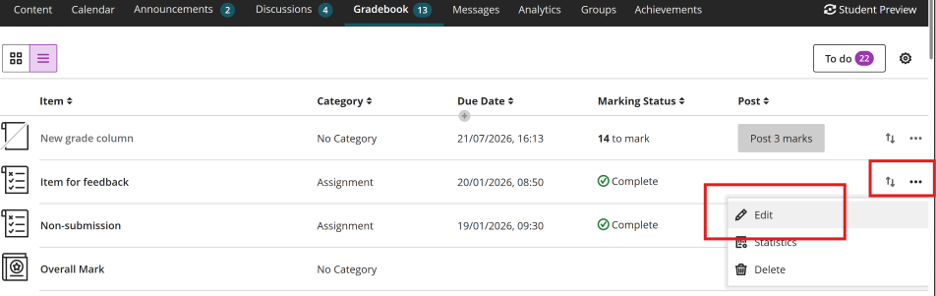
Replaced the Edit option with a View Submissions option using the eye icon.
Renamed the grade cell menu option from View to View Submission.
Manual Items, Calculations, Total Calculations:
Added a View option to the column header that routes to the submission page.
SCORM Items:
Added a View Submissions option with the eye icon.
Renamed the grade cell menu option to View Submission.
Removed Edit and Preview SCORM options from the column header menu.
Attendance:
Replaced the Edit option with a View option using the eye icon.
Navigation behavior remains unchanged, with users being routed to the attendance page.
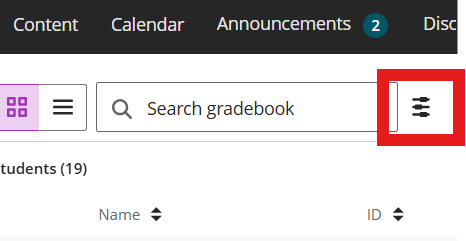
Image 1: Improved navigation in the Gradebook column headers.
If you have any enhancements to request from Blackboard, please get in touch with us via elearning@aber.ac.uk.
To assist colleagues, we have a training session available on Wednesday 10 December at 10:10. Places can be booked online.
In addition to this, we are running 4 E-learning Excellence training sessions (based on the 4 assessment criteria). These sessions are available to all colleagues, whether they are considering submitting an application or not. Places can be booked online.
If you have any questions, please contact the Digital Education Group (elearning@aber.ac.uk).
We’ve had a look at all the queries that came into the elearning@aber.ac.uk inbox over September to see what the most common query was. And the answer is … Merged Courses.
So, here’s some useful information about merging courses which can help to answer some of your queries:
A merge links two or more courses together in Blackboard. It is an effective way of dealing with separate courses that have the same content, so you don’t have to upload materials to more than one course. More information is available on the blog. Some cases where this might be useful are
Modules are taught the same content but there’s a module available for 2nd and 3rd years.
Modules that bring together different degree schemes and have different module IDs, e.g. dissertation modules.
Courses aren’t merged automatically so you will either need to merge them via our new Module Partners tool or by emailing elearning@aber.ac.uk . If your courses were merged last year, you need to merge them again for 2025-26. If you want to check whether your courses have already been merged, you can use Module Partners (or email elearning@aber.ac.uk)
Students will see the module code and title of whichever course they are registered on. If you find that students can’t see content in courses that you think are merged, please check in Module Partners or email elearning@aber.ac.uk to check.
We’ve also had questions about enrolments – information about how enrolments work is available in our Access to Blackboard Courses FAQ.
Note: we produced the summary of our most common support queries using Microsoft Copilot.
On November 18, Aberystwyth University will join institutions worldwide for Fix Your Content Day 2025, hosted by Anthology. This 24-hour competition is part of our ongoing commitment to inclusive education.
We’ll be hosting a drop-in on 18th November between 2pm and 4pm in B23 Llandinam. E-learning Staff will be available to answer questions and help you use Ally (tea and biscuits also provided).
Together, we’ll aim to fix as many accessibility issues and course files as possible using Anthology® Ally. Every fix—big or small—contributes to a more inclusive learning environment for all students.
How you can help:
Review your courses for red and orange indicators
Focus on quick wins like adding image descriptions or improving Microsoft Word documents
Start fixing on November 18 and keep things going throughout the day
Aim for 100%, but improvement is what counts!
For more information on how to fix files using Anthology Ally, have a look at our FAQ on Ally.