Your First Assignment

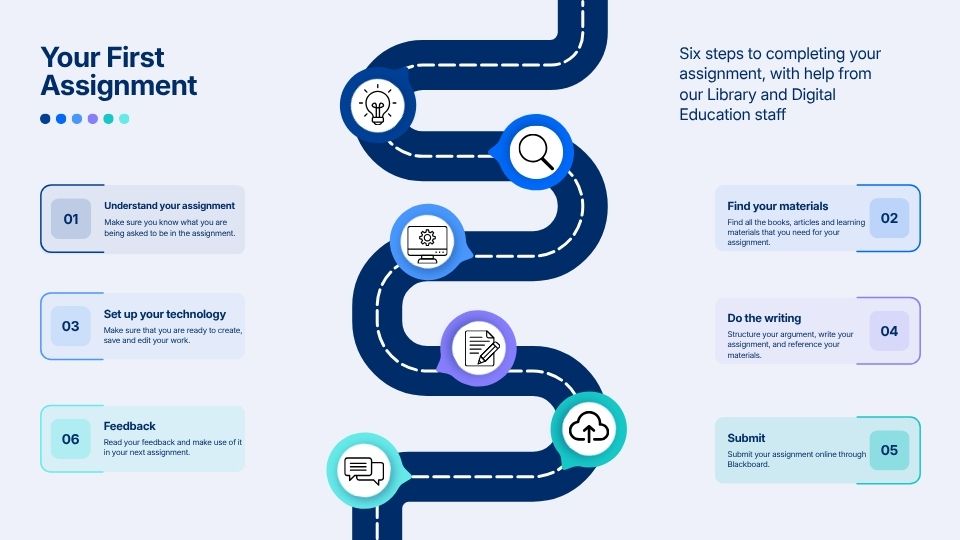
6 steps to completing your assignment:
1. Understanding your assignment
2,. Finding your materials
3. Set up your technology
4. Do the writing
5. Submit 
6. Feedback

Got your first assignment coming up? Between 19 and 23 October, we’ll be sharing advice, resources and events to help you get started.

We’ll guide you through each stage of the process, from understanding the assignment brief and finding the right information to planning, writing and submitting your work with confidence.

And it’s not just for first-years. If you’re in your second or third year, you’ll also find useful tips and support to help with your assignments.

Monday 19th: Understanding your assignment

  • AberSkills drop-in with Non between 10:00 and 12:00 (Level D, Hugh Owen Library)
  • Dehongli eich aseiniad gyda Tamsin (Teams, 13.30-14.00)

Tuesday 20th: Find your materials

  • Finding the Good Stuff: Peer-Reviewed Articles with Anita, 10:00-10:10, 11:00- 11:10 and 12:00 – 12:10 (Teams).
  • Library tour with Simon at 14:00 (meet on Level D, Hugh Owen Library)

Wednesday 21st: Set up the technology

  • Digital Skills Café drop-in with Keziah between 13:30 and 15:30 (Level D, Hugh Owen Library)
  • Offer cyfrifiadurol ar gyfer ysgrifennu Cymraeg gyda Tamsin, 14.00-15.00 (Teams, 14:00 – 15:00)

Thursday 22nd: Writing Your Assignment

  • Meet Samanatha Wynne-Rhydderch, Royal Literary Fund fellow and published author between 10:30 and 13:30 (Level D, Hugh Owen Library)
  • Visit Tamsin Davies, Welsh Skills Tutor, for advice about writing your assignment in Welsh, 12.00 – 14.00 (Level D, Hugh Owen Library)
  • Library tour with Simon at 14:00 (meet on Level D, Hugh Owen Library)

Friday 23rd: Submitting Your Assignment

  • Submission drop-in with Luke between 10 and 12 (Level D, Hugh Owen Library)

All week:

  • Level F enquiry desk: 11:00 – 15:00
  • Book displays in Hugh Owen Library and Physical Sciences Library

Everything will be available on Ffrwd  so have a look during the week. Good luck!

A free, confidential service to help you improve your writing skills

Improve your academic writing this year with RLF Fellow Samantha Wynne-Rhydderch. To make an appointment please email for a booking link: samantha.wynne-rhydderch@rlfeducation.org.uk

Students at Aberystwyth University at any level of study (from 1st year to postgraduate) – and staff – are welcome to book a session.

The Royal Literary Fund Writing Fellows are professional, published authors whose role is to help you strengthen your writing. In one-to-one sessions, Samantha can help you with:

  • Structuring your argument
  • Writing clearer and more compelling prose
  • Rewriting and editing
  • Planning and time management
  • Tackling the word count
  • Critical thinking
  • Paraphrasing

Samantha works Wednesdays and Thursdays during term time. Sessions last 50 minutes and take place in the Hugh Owen Library on Wednesdays and the Llandinam Building on Thursdays.

Samantha Wynne-Rhydderch

Please note that RLF Writing Fellows do not undertake proofreading, or EAP or TEFL tuition.

Note: Samantha’s sessions are in English. To speak with a Welsh medium academic writing skills tutor who offers 1:1 academic support to students, please contact Dr Tamsin Davies, ted@aber.ac.uk

Am I allowed to use AI? (And other small, existential questions)

Am I allowed to use AI?
Is it cheating?
Will my lecturer know?
Am I accidentally helping to boil the oceans or fund a tech billionaire’s next rocket?

These are just some of the many, many questions around AI, and If you’ve asked yourself any of them recently, you’re not alone. AI has moved very quickly from “What even is this?” to “It’s everywhere and I’m not sure how I feel about it.” It can get pretty confusing.

That’s exactly why we’ve created our new AI Literacy course.

Rather than telling you what to do, the course focuses on helping you decide what’s right for you. Because using AI isn’t just a technical question, it’s an ethical one too.

As you move through the course, you’ll explore questions like:

  • What actually is AI?
  • Am I still doing my own thinking?
  • Can I trust this output?
  • What am I sharing, and where is it going?

We look at AI as a study partner, not a shortcut. It might be a tool that can help you plan, explain, or get unstuck, but it’s not there to replace your learning. Along the way, we connect AI to things that you will be developing at university, and which we hope will serve you well in the future: critical thinking, information literacy, and ethical awareness.

You’ll also explore what’s really happening when you use these tools, including data privacy, referencing pitfalls, accessibility, environmental impact, and how well (or badly) they handle the Welsh language.

Importantly, the course also makes space for a perfectly valid position: What if I don’t want to use AI at all?

We hope that the course will give you the confidence to make an informed choice, and not just follow the crowd.

AI isn’t going away. It’s already built into the tools you use every day, from search and email to library resources and learning platforms. This course isn’t about chasing the latest trend. It’s about helping you navigate a world where AI is already part of the landscape, and offering practical ways to think clearly, act responsibly, and stay in control.

The course is available to all students and staff via Blackboard Organisations and there is also a link here.

What to Expect On A Library Tour

For many students, library tours are a useful way to get their bearings during Welcome Week. We also know that starting university, visiting a new building, and meeting new people can feel a little overwhelming when you’re not sure what to expect.

To help with that, we’ve created a new online guide: What to Expect on Your Library Tour.

The guide takes you through the library tour experience before you arrive, including where to go, who you’ll meet, what the tour covers, and what to do if you’re running late. There are also photos of key locations, accessibility information, and details of the support available if you need it.

The guide isn’t intended to replace the tour itself. Instead, it’s there to help you know what to expect, feel more prepared, and decide whether there is anything you might want to ask about in advance.

Whether you are looking forward to exploring the library, prefer to plan ahead, or simply like to know what to expect before trying something new, we hope you’ll find it useful.

A link to the new guide is here