Why You Shouldn’t Let AI Do Your Bibliography for You

Look, I’ve been there. It’s 2am and you’ve got an assignment due later that day. Your references are looking a bit thin, and the temptation to ask an AI tool to whip up some citations for you can be irresistible. One prompt and you’ve got a neat list of journal articles and books. Perfect, right? Well… not always.

Here’s the catch (there’s always a catch!): AI tools are great at generating convincing-looking references. The titles sound plausible, author names are familiar, and the journals look legitimate. But sometimes appearances are deceptive, and the references have no connection to reality. This is what people mean when they talk about AI hallucinations. The tool invents a source that looks perfectly credible but doesn’t actually exist.

Why does this matter?

  • The most important reason is: that you shouldn’t put anything in your bibliography that you haven’t actually read. A bibliography isn’t just a list of things that might support your argument; it’s a record of the sources you’ve genuinely engaged with. If you haven’t read the book, article, or paper, you can’t know whether it really says what you think it says, or whether it fits your argument at all.
  • Putting a made-up citation into your work undermines the credibility of your whole assignment.
  • Your lecturers and tutors can (and often will) check your references. If they can’t find them, it’s a problem.
  • Good referencing isn’t just box-ticking, it’s how you show you’ve done the reading and can back up your ideas. It’s also about giving proper credit and joining the scholarly conversation.
  • Universities take referencing seriously: misusing or inventing sources can be flagged as poor or even unacceptable academic practice, with real consequences for your marks.

So what should you do?

  • Verify, verify, verify! If an AI gives you a reference, always double-check it against a reliable source – in the library catalogue, Google Scholar, or a subject database.
  • Ask your librarian. That’s what we’re here for. We can help you find legitimate, citable sources, show you how to search databases effectively, and help you guide you through proper referencing styles so you don’t have to wrestle with formatting at 2 a.m.

AI has lots of uses, but it’s not infallible, and it’s definitely not a replacement for critical thinking (or a decent library search).

So next time you’re tempted to drop those AI generated citations straight into your bibliography, stop, double-check, and if you need help, turn to your librarian, although if it’s 2 a.m., the library catalogue is probably your best bet!

For more information on AI can be found here.

The usefulness of reference generators…and a word of caution

Reference generators like MyBib and Scribbr have become popular tools for students navigating the complexities of academic writing. These tools simplify the process of formatting citations and bibliographies, which means you get to save some precious time! However, while they are good starting points to quickly generate a reference, you should approach them with responsibility and caution.

Strengths of MyBib and Scribbr

  1. Ease of Use: Both MyBib and Scribbr are user-friendly, offering intuitive interfaces that allow you to input resource details quickly and generate citations in referencing styles like APA, MLA, Harvard and many more.
  2. Key Features:
    • Creates references for a variety of resources, including books, e-books, journal articles, websites and more!
    • MyBib integrates seamlessly with platforms like Word, ensuring smooth workflows during document drafting.
    • Scribbr offers features like secure backups and annotations to enhance organisation and protect work.
  3. Free Accessibility: Both tools are free to use, making them accessible to students across various academic levels. You can use them without an account or sign up for a free account to unlock more features.

Limitations to Consider

While these tools are helpful, they are not perfect. You should be aware of the following limitations:

  1. Accuracy Issues:
    • Citation generators can occasionally misinterpret uncommon or complex sources, leading to formatting errors.
    • Automated tools may struggle with non-standard references such as datasets or foreign-language texts.
    • Common errors by these tools are capitalisation, punctuation, spacing, formatting and even incorrect information or placement.
  2. Over-Reliance Risks:
    • Blindly trusting these tools without verifying the output can result in incorrect citations that compromise good academic practice. Do not just copy and paste the reference from MyBib or Scribbr directly into your assignment without checking (and checking again!) for accuracy.
    • Errors in citations can lead to deductions in grades and/or even accusations of plagiarism.

Best Practices for Responsible Use

To use citation generators effectively while minimising risks, you should follow these guidelines:

  1. Verify Every Citation: Always double-check the generated references against official style guides and your departmental guidelines to ensure accuracy and that you don’t lose marks for your referencing.
    • Ensure you’re following your departmental referencing style – check your department and module handbook.
    • Check the generated reference against the examples given in the Referencing and Plagiarism Awareness LibGuide. Tab 8 of the LibGuide has departmental referencing examples – find your department and cross check the reference for the source used (e.g. book, e-book, article, website etc.) is written in the correct format and order.
    • Seek guidance from your Subject Librarian. They offer one-on-one consultations and are experts in the specific referencing styles used in your fields of study.
  2. Understand reference rules: Familiarise yourself with the principles of academic referencing to spot errors and make necessary corrections – these reference generator tools are handy, but they can’t replace the skill of and the importance of knowing how to reference correctly.
  3. Use as a Starting Point: Treat tools like MyBib and Scribbr as initial aids rather than definitive solutions. They simplify the process but do not replace critical thinking or attention to detail.
  4. Cross-Check Sources: For complex or uncommon sources, consult additional resources or seek guidance from your Subject Librarian.
  5. Avoid Over-Reliance: Make sure to find a good balance between automation of these tools and manual effort—it’s all about staying in control of your academic work and learning the skill of referencing for yourself.

Yes, MyBib and Scribbr are valuable tools for simplifying citation management for academic writing. Their ease of use and accessibility make them ideal starting points for working on assignments. However, a few words of caution. They are not flawless, foolproof nor entirely reliable – it is essential that you double check and verify what is generated for accuracy. These tools should not be used as a substitute for a comprehensive understanding of citation and referencing style rules. Responsible use of these tools ensures that good academic practice is upheld while benefiting from their convenience.

Unlock the Power of Healthcare Knowledge with Your Library Databases!

Navigating the world of healthcare can feel incredibly overwhelming. The feeling of being time-poor while juggling personal commitments, lectures, and clinical placements can be intense. So, when it comes to research for assignments or understanding complex conditions, it can be hard to know where to start.

Rather than time spent on endless online searches that can lead you down rabbit holes of questionable websites and outdated information, your library invests in premium healthcare databases like CINAHL, MEDLINE, British Nursing Database (and many more!) for a reason – they are goldmines of credible, peer-reviewed research specifically for healthcare.

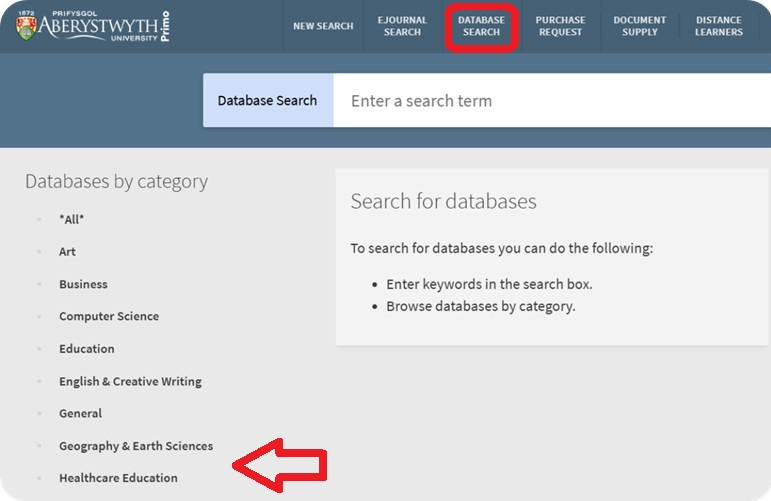
Our Database Search page is fully integrated within our main library search tool and can be found at the top of Primo, so no need to remember any separate URLs.

The Database Search is divided up into different subjects so you can browse resources applicable to your course. Alternatively, you can search by key terms and draw results from the whole of the collection.

Befriend these databases for:

  • Reliable, up-to-date evidence: These databases curate information from reputable journals.
  • Targeted Information: Use specific keywords and filters to pinpoint articles directly related to your topic, whether it’s wound care, mental health nursing, or diabetes management.
  • Evidence-Based Practice at Your Fingertips: These databases help provide the foundation for understanding the “why” behind the practice, helping deliver the best possible services based on solid research.
  • Academic Success: Using credible sources from these databases will strengthen your arguments, demonstrate critical thinking, and ultimately lead to better grades.
  • Expanded knowledge: Broaden your understanding of healthcare topics for career preparedness.

Don’t know where to start?  

  1. Sign in to Primo – your library catalogue.
  2. Search in the ‘Database Search’ for your database – follow any off-campus notes if needed.
  3. For further information and support, see your LibGuide or contact your librarian.

Happy researching!

AI and the Library. Week Seven: The Ethics of Using Generative AI (Part Two)

Be transparent about your AI Usage

Before we get properly underway, let me just reiterate that you must always follow any university and departmental guidance on using AI tools in assessed work.

In our last post on the ethics of using generative AI, we started looking at the importance of understanding the responsibilities that come with using these tools. The key message in that post was the need to familiarise yourself with Aberystwyth University’s guidelines on AI usage.

This week, we’re covering another important topic: being transparent about your use of AI tools in assessed work.

As generative AI becomes more widely available, universities are emphasising the importance of academic integrity and clear disclosure when using these technologies.

Using AI can be a valuable aid in research, brainstorming, and drafting, but it’s essential to be upfront about how and where you’ve used it.

Being open about your use of AI tools is vital for maintaining academic integrity. Transparency shows your commitment to honesty and ethical study practices.

Key Takeaway: Why Transparency Matters:

  • It demonstrates your academic honesty.
  • It reflects your commitment to ethical study practices.
  • It highlights your critical thinking skills.
  • It reinforces your professional accountability.

How to Acknowledge AI Usage:

Academic departments and module coordinators will be best placed to advise you on how you should acknowledge AI outputs. These might include:

  • AI tool-use statements.
  • Advice on correct referencing and citation practices for AI outputs.

You can find additional help and support on using AI here: Artificial Intelligence  : Information Services , Aberystwyth University