AI can be a valuable tool to help you to get the most out of your time in the library. By utilising the conversational style of AI tools like ChatGPT, you can collaborate with the AI to refine searches, get personalised recommendations, and quickly discover relevant resources that meet your specific academic needs.
To get the best results from AI, it’s important to ask the right questions, and this is a skill in itself,

This skill, known as prompt building or prompt engineering, involves structuring your queries in a way that directly impacts the usefulness of the AI’s responses. Mastering this technique can significantly improve your results from AI tools. (For more on the importance of effective prompt building, see our AI and the Library Guide here).
What is an effective prompt?
A good AI prompt is concise, structured, and specific. You might like to think of it as a formula, where each element plays a role in making the prompt clear, targeted, and focused on the desired outcome.
The elements of the formula might look something like this:
Task + Topic + Structure + Style + Level
Let’s have a look at what we mean by those elements and how we might apply them in a library scenario.
The Task component of the formula specifies what you want the tool to do. Some examples might include: Find; Summarise; Explain; Describe; Compare.
The Topic defines the subject matter or scenario that we want the Task to explore. Examples might include: The Origins of the Second World War; Romanticism in English Literature; The Aims of Positive Psychology.
The Structure specifies the format in which the response should be presented. You could ask for responses in: One Sentence; 200 words; A Bullet Point List; A table; A Graphic or Chart.
The Style specifies how the content should be written. Styles might include: Formal; Informal; Academic; Witty.
The Level of detail indicates the depth and scope of the information needed. This level of detail could be a Basic Overview or an In-Depth Analysis (or anywhere inbetween!)
Here’s an example that you might use in the library. You want to find some library resources that will help you to answer the following question: “Analyse the themes and characteristics of English Romanticism in the poetry of William Wordsworth and Samuel Taylor Coleridge.”
- Task: Find
- Topic: Books that discuss English Romanticism and the poetry of William Wordsworth and Samuel Taylor Coleridge
- Structure. A bullet point list
- Style. Academic
- Level. An introductory overview
The full prompt may look something like this:
Please find me some academic books that give an introductory overview of English Romanticism and the poetry of William Wordsworth and Samuel Taylor Coleridge and show them in a bullet point list.
This was the output that the AI provided* (for this example, we used perplexity.ai, a tool we will be reviewing in our next AI blog post):
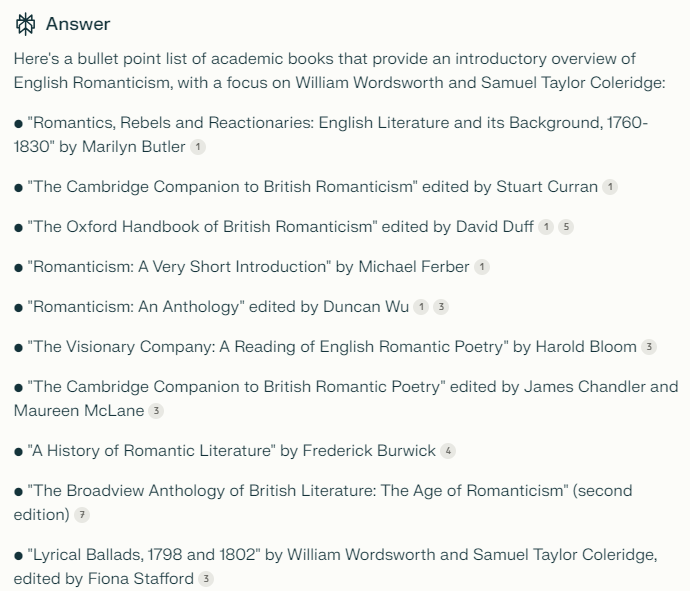
*We always recommend checking any AI outputs for accuracy.
By getting to grips with the art of prompt building, you can more effectively communicate your needs to the AI. This ensures that the responses are both academically relevant and that they meet your specific learning needs – saving you time spent searching. You could then visit Primo, the library catalogue to see if the library has the suggested titles available for you.
As demonstrated in our example, a well-structured prompt can help you uncover valuable academic resources that can quickly help you get a better understanding of topics.